
Chapter 2
INDUSTRY 4.0 EDUCATIONAL DIGITAL MODERNISATION: A STUDY FROM BANGALORE BUSINESS SCHOOL
- M.R. SUJI RAGA PRIYA (Assistant Professor, Dayananda Sager Business School)
- Dr. HEMALATHA R (Head - Training & Placements, Global Group Of Institutions)
- ISBN
- 978-81-963834-0-4
- Published
- 26 July 2026
- Accesses
- 49 views · 47 downloads
- Reading time
- ~19 min
Abstract
The digitalization of education sector services within the framework of achieving sustainable development objectives, notably environmental sustainability. The purpose of this paper is to demonstrate the significance of an educational platform for the digital modernization of Russia's regions in Industry 4.0 and to identify the functions and conceptual foundations of the regional market of educational services for the execution of functions to stimulate the digital modernization of the regional economy in Russia. It has been determined that the market for educational services plays a significant role in the transition of regions of contemporary Russia to Industry 4.0, serving two functions: the training of personnel who are capable of working with digital technologies and the training of personnel who are capable of developing new digital technologies within a region's businesses. The consequence is the formation of an educational platform for the digital transformation of the regional economy. The developed conceptual foundations of an organisation of the regional market of educational services for the execution of its functions on stimulating the digital modernization of Russia's regional economy permit three variants of the process of personnel training: within execution of the order of partner companies in a regional technological park, within participation of the region's companies in a tender for personnel training, and within an independent initiative.
Keywords: Educational Sector, Post Pandemic, Digitalization, Sustainability
Full text
Introduction
Digitization concerns are growing. Digitalization has influenced every element of human life, including the household, market transactions, financial operations, banking, industry, agriculture, medical, education, and government. Digitalization has beneficial and bad impacts, such as saving time on data transmission and decreasing the cost of work operations (Yli-Viitala et al., 2019). Negative implications include new sorts of digital fraud and an over excitement for virtual reality (Tvaronaviien, 2018; Zhao et al., 2019; Chehabeddine, Tvaronaviien, 2020).
Science and technology advances and limited economic resources force the national economy to embrace digital technologies. Digitalization procedures must be investigated to avoid negative effects and enhance positive ones. To achieve national development goals and protect individuals,
institutions must make digitalization controlled. According to these documents, their outcomes should be an increase in domestic costs for the development of the digital economy from 1.7% to 5.1% of the country's GDP; the creation of a stable and secure information and communication infrastructure for the efficient transfer, processing, and storage of large amounts of data by organisations and households; and the use of predominately domestic software by state authorities, local government, and businesses (Vu, 2019; Vural, 2019; Fedulova et al., 2019; Sturm and Quaynor, 2020; Herningsih et al., 2019).
Such large projects need trained human resources, developers, and digital technology users. Universities must become digital, and the national innovation system and important development organisations must consider its ramifications (Selomo & Govender, 2016: Soleimani & Esfahani, 2018). The European Commission's Digital Education Action Plan defines digital competence as follows. Digital competence is the ability to use information and communication technologies confidently, efficiently, critically, and securely (Dvir & Yemini, 2017; Amirova et al., 2019; Ivanova et al., 2019; Pavlyshyn et al., 2019). Digital competence includes knowledge, skills, motivation, and responsibility, including safety. User basic digital skills require functional literacy in the use of electronic devices and applications; derivative digital skills consist of the ability to consciously apply digital technologies in everyday life; creative skills for working in digital services are important; specialised professional digital skills are the foundation of high-tech professions, for their development (Zeibote et al., 2019; Yemelyanov et al., 2018; Masood et al., 2019).
Only by improving digital literacy can education be fully digitised. To increase digital literacy, programmes and organisations must be created. Micro and macro institutional conditions for digitalization must be examined.
Literature Review
External pressures, such as globalisation and digital technology, require current institutions to adapt and create a new framework for human interaction. There are also reverse processes - institutions, especially those in the national innovation system, impact the quality and content of innovation processes and the use of digital technologies to ensure effectiveness and safety (Freeman, 1987; Lundvall, 1992; Nelson, 1993; Sycheva et al., 2019; Nagimzhanova et al., 2019). In this regard, micro- and macro-level digitalization of the nation's education is urgently needed. Knowledge and human capital are increasingly important in modern businesses and services. Science and technology have expanded limited economic resources, given consumers with new goods and services, and helped national enterprises innovate globally (Singareddy et al., 2019; Akhmadeev et al., 2018). These patterns have several causes. First, business globalisation and digitalization. Globalization reduces national economic barriers while digitalization integrates research, education, industry, and the market. This causes colleges to expand both physically and virtually. Universities may establish a digital intellectual resource. Due to the growth of distance education, there's more time to examine theoretical and practical course materials.
In a unified digital area of the scientific, educational, and commercial domains, teachers have
access to hypertext information systems and technology. The state must promote the digital transformation of universities, shifting the focus from internal socioeconomic difficulties to external market conditions of demand for educational and research commodities (Nedelkin, 2018; Saenko et al., 2020; Polyakova et al., 2019; Magsumov, 2019a,b; Mullins, 2019; Franco and Bedin, 2019). Universities have long played a key role in societal development (Bykanova and Akhmadeev, 2019). The university is a centre for knowledge, culture, education, individual initiative, socialisation, and relationship-building. Due to a worldwide focus on innovation, colleges have become centres of creative demands and proposals. To accomplish this responsibility well, colleges must evolve faster than the outside world. Colleges are challenged by the new industrial (digital) revolution 4.0. Paradigm shift needed to drive digitalization of economy (Chichenev, 2019; Sousa et al., 2019; Girdzijauskaite et al., 2019).
A contemporary university's digital system comprises of an Internet portal, student and faculty personal accounts, electronic educational materials, libraries and reference books, and modules for automating educational, administrative, and financial tasks. The digital capabilities of a contemporary university make it feasible to automate the conventional workflow (Rosa et al., 2019), which includes the formulation of contracts, orders, resolutions, reports, service requests, and other administrative choices. Incorporating data analysis units into the digital environment of a contemporary university will facilitate the evaluation of the unique features of students and faculty, the construction of individualised educational paths, and collaborative scientific research. Future integration of university digital environments may result in the establishment of a universal, mixed, human-machine intellectual resource that permits the growth of inventive activity to reach new heights.
University 4.0 is a component of a cognitive society, where the activities connected with the generation, processing, exchange, and diffusion of information become fundamental. The creator of knowledge is transforming into a collaborative (human-machine) intellect. Digital technologies enable the use of human and machine intelligence to solve difficult issues not only in the economic sector, but also in the cultural and social spheres. The society gains the characteristics of network interaction, and individuals get access to the collective consciousness. Using digital technology and the Internet, a person may affect the actions of other individuals in real time. In such circumstances, a unique culture of will and trust is required to enable the concentration of cognitive capacities, the fixation of meanings and goals, and the essential filtering of information and communications. Universities are becoming into platforms for communal knowledge, while all external connections are eliminated. Employees and students of the university actively engage in collaborative search activities to generate shared meanings while keeping their distinct perspectives and establishing effective communication links.
Coordinating promising research, creating businesses, implementing and enhancing a communications network, and promoting digital technologies are becoming the university's responsibilities (Efimov & Lapteva, 2017).
Figure 1: Educational Institution & Digitalization
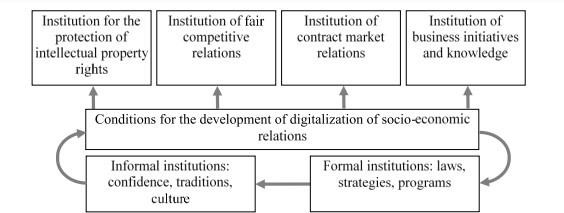
Foreign experience with digital economy transformation indicates several ways. Literature classifies the paths of digital economy growth as the production sector (Germany), the service sector (United Kingdom), with priority governmental backing (China), and with priority in the development of private ventures (United States) (Polozhikhina, 2019). However, the literature does not adequately address the institutional aspects of ensuring efficient and secure digitalization of the economy, and for the educational system.
Methodology
On the basis of Bangalore's Business institutes, a study was done on digital technology's difficulties and results. The study revealed the main problems and ways to improve digital competency. 150 faculty members were polled for the estimations.
Table 1: Digitalization Barriers in educational Institutions
Barrier (Variable) | Indicator Value | Std. Dev. |
|---|---|---|
B1: Many aspects impossible to discuss remotely | 1.53 | 5.95 |
B2: Difficulties in motivating customers to explain certain aspects electronically | 3.33 | 11.24 |
B3: Formation of ambiguities and misunderstandings during electronic consultation with the client/investor. | 2 | 7.9 |
B4: Legal problems (procedures requiring signatures and original documents) | 5.4 | 8.35 |
B5: Problems related to the place of activities (presence at the investment site) | 2.22 | 8.17 |
B6: Problems with access to documentation and data | 1 | 7.6 |
> Table 2: Factors impacting the digitalization
Factors Contributing to Digitization | Std. Dev. | Indicator Value |
|---|---|---|
F1: Better and more flexible contact with the client/investor due to the use of electronic communication | 5.93 | 2 |
F2: Facilitated contact with the project team | 6.32 | 2 |
F3: Facilitated cooperation with representatives | 7.8 | 2.5 |
F4: Higher work-at-home efficiency | 13.81 | 3.33 |
F5: Higher working comfort at home | 14.1 | 4 |
F6: Using more effective, faster, and productive | 8.6 | 2.86 |
> Hypothesis: > > H0: There is no significant impact of digital implementation in the educational institution H1: There is significant impact of digital implementation in the educational institutio Table 3: Regression analysis considering impact of digitalization on education sector > > Regression statistics
Multiple R R2 0.9222 | 0.9603 | |||||||
|---|---|---|---|---|---|---|---|---|
Adjusted R2 | 0.9081 | |||||||
SE 2.4762 | ||||||||
Observations | 14 | |||||||
Dispersion analysis df | SS | MS Regression | 2 | 799.5210 | ||||
399.7605 Residual 11 | 67.4464 | 6.1315 | F 65.1979 | Significance F 0.000001 | ||||
Total 13 | 866.9674 | |||||||
Coefficients | SE t-statistic | Y-intercept | ||||||
13.7608 | 4.7022 2.9265 | |||||||
x1 | 0.0665 | 0.1585 0.4197 | ||||||
x2 | 0.6591 | 0.1195 5.5139 | ||||||
p-value | Lower 95% | Upper 95% | ||
|---|---|---|---|---|
0.0138 | 3.4114 | 24.1102 | ||
0.6828 | —0.2823 | 0.4153 | ||
0.0002 | 0.3960 | 0.9222 | ||
Source: Calculated and compiled by the authors > Table 3 shows regression analysis considering variables, Independent Variable usage of digital technology in educational system and dependent variable high performance and productivity using technology. > > R square value is 0.9 >0.5 proves that there is significant impact of digital implementation in the educational working. P value = 0.013<0.05 proving significant fit for the model. > > The offered authors’ recommendations ensure the following advantages during creation and development of the educational platform of region’s digital modernization in Industry 4.0: - High marketing activity of universities, which ensures large-scale information support for the process of personnel training; - Direct sequence of training of personnel: regional universities determined the needs of the region’s companies for personnel and then adopt educational programs and conduct training of personnel, which guarantees their demand in the labor market; and - Improved treatment of effectiveness of regional universities as a ratio of efficiency in personnel training (according to the criterion of number, demand and quality) to expenditures (government financing, assets and reputation in the market of educational services), which stimulates the competition between universities and maximization of effectiveness of the educational platform of region’s digital modernization in Industry 4.0. > To speed the education system's digital transition, institutions that promote the use of digital technology are necessary. Indirect stimulation should be guaranteed by incorporating digital media into the learning process. There is a need for adequate digital infrastructure. This will encourage the usage of digital technologies. Digital literacy must be ensured not only in the professional sphere, but also in multidisciplinary and daily activities. It is vital to build an institution that provides consistent, lifelong instruction in digital literacy and the creation of digital competences beginning in early childhood. Employers already seek such skills from incoming college grads. Improving the institution of intellectual property and copyright in the usage of digital technology is also required. Knowledge and information, which are the primary objects of use in digital technologies, have the quality of being separate from their source and, as a result, need more intricate protection of commercial rights in order to be used. On the other hand, knowledge and information also possess the characteristic of "club commodities," whose value grows with more usage. Such inconsistencies need the reform of copyright law. Discussion > Researchers of the digitization phenomena have seen substantial shifts in all spheres of socioeconomic activity, including higher education (Vasetskaya, 2018; Ziyadin et al., 2018; Tikhonov et al., 2019). The following are the effects of digital transformation on academic institutions: The implementation of fundamental information services — the establishment of a unified digital environment. This orientation permits digital interaction amongst all participants in the educational and research processes. (Korableva et al., 2019a, b) 4.0 service including research project management, procurement management, scientometrics digitization, and teacher-student interaction. This strategy permits the interaction processes of all study participants to be rebuilt on a fresh foundation.
Digitalization facilitates the effective organisation of knowledge-sharing interactions. Real-time engagement is taking place. Teachers, personnel of scientific departments, and students may collaborate to tackle innovation-related issues. The university's commitment to the deployment of "smart manufacturing" In this way, the institution joins the new digital realm created by the introduction of Internet technology to economic activity, production and services, family activities, and daily life.
Cognitive processes, online objects administration, big data analysis, and cloud storage are now widely used technologies. It appears pertinent to examine a digital transformation of the university as a process of generating new business circumstances, the interaction of all students and university personnel on a new, digital platform linked into the digital economy platform of the nation and the globe.
Digital technology enables the creation of a student's digital profile, which takes into consideration his or her unique, physical, psychological, national, and social qualities. This enables the selection of the most suitable digital profile tools and training techniques (online and offline, problematic, practice-based), as well as the mode and forms of instruction (full-time and distance, mixed, individual and group).
Consequently, the digital profile of the student is an additional factor in creating the digital system of the new institution (Bockshecker et al., 2018: Villalobos, 2018). The modern digital environment of the university is a combination of information systems, technologies, and services that permit conducting educational, research, methodological, administrative, and business activities in digital format, working remotely, in real time via the Internet from any location to enter information into the digital environment of the university and use the data presented in it. Modern university digital environments have security, openness, accessibility, adaptability, dependability, reactivity, and informative content.
According to experts, the contemporary digital period is defined by the advent of such breakthroughs, the development of which needed the collaboration of a large number of individuals with diverse professions and motives. The circumstances generated at a business or university for the exchange of knowledge, especially on the long term for that at the level of intercorporate (inter-university) collaboration, are crucial to the success of any innovation process, including the development and use of digital technologies (Yagolkovsky, 2011). Knowledge sharing fosters a conducive socio-psychological environment for workers (Yankovskaya et al., 2019).
The elements that influence the open sharing of information include confidence, creative drive, organisational culture, and cognitive activity (Brachos et al., 2007). Therefore, it is vital, on a personal level and in the first phases of using digital technologies, to implement steps that enable the open interchange of knowledge and information. In contrast, firms and colleges are organisations that compete for diverse economic resources in a market system. Corporations compete for customers of their goods, while colleges seek candidates. This competition is intensified by digital technology, making it more dynamic and adaptable. Those businesses who have started the production of competitive items at the most appealing prices and levels of quality get the most sales revenue. Budgetary resources are allocated to institutions with more impressive research outcomes, graduate employment rates, and contractual commercial relationships with the real economy. The growth of their corporate information systems, digital educational technologies, digital environment, and communications is motivated by organisational competition. Competition is acknowledged as the driving force behind all inventions (Schumpeter, 1982).
Accordingly, the government must encourage the competitive process at the organisational level for firms and colleges. In Russia and throughout the globe, rating procedures and contests are extensively employed for this purpose, resulting in the provision of money. Conditions for the creation of a competitive environment include private property, freedom of entrepreneurial
activity, freedom of consumer choice, personal interest priority, and a restricted government involvement (Khasanova, 2016). Consequently, at the organisational level and at the stages of utilising digital technologies, where intellectual property rights are clearly defined, the development of suitable institutions is required: competitive conditions, state support on competitive terms, and public centres for collective use. The protectionist model of Indian education proposed by the authors in the context of the digitalization of the economy should include institutions of cooperation and knowledge sharing at the personal level of using digital technologies, and institutions of competition and fair competition for limited economic resources, including human capital, at the organisational level and stages of the market interaction of participants in the digital environment. In this context, the state strategy aimed at attracting and retaining the finest staff in the school system should consider this theory. The objective is not to allow employees to work overseas or for multinational corporations, but to foster the creative growth of scientists, researchers, and innovators and to sustain the competitiveness of Indian institutions and the actual sector of the economy.
Conclusions and Suggestions
The micro-level examination of the institutional environment using the university as a case study enabled the formulation of the following findings and suggestions. The following components must be included into educational programmes: - motivating, aimed at defining particular objectives, showcasing the possibilities and significance of digital learning; - modelling, the primary objective is to envision the model of "a digital world citizen." The organisation of programmes should take into consideration, among other things, the peculiarities of the Internet activities of parents and kids, since the usage of digital devices rises dramatically on weekends and pupils are focused on acquiring information rapidly. Therefore, there is a need for educational programmes that are not connected to the school day, can be accessed from anywhere, and encourage the interchange of experiences and collaboration.
An effective educational programme should focus on the development of responsibility and the ability to ensure the safety of students and parents in the digital space, as well as the development of specific Internet skills, namely: working with information; communication; the technological realm; and consumption. Additionally, both adults and students must have an active and independent Internet presence. When dealing with parents, the most essential goal is to bridge the digital divide and educate them in the proper evaluation of their ability to assist pupils with Internet work. It should be emphasised that Indian users are more likely to participate in a digital competence-building programme that provides them with communication, collaborative search, and developmental games than in a programme resembling an electronic textbook. Thus, the significance of the conscientious and ethical use of digital technologies in training and daily activities, based on trust between digital product users, is highlighted. According to the findings of the aforementioned research, the process of developing digital capabilities in Russian pupils faces several obstacles. The international categorization divides the digital abilities underlying digital competences into user and specialist categories. The authors argue that digital competence must comprise, in addition to specialised knowledge, skills, and talents, the capacity to collaborate digitally, protect its security, and address digital issues. The personality of the instructor, his/her professionalism, and desire to grow; educational possibilities; parental activity and mobility; and the amount of student enthusiasm to study all play a significant part in this process. The analysis of the macro-level institutional environment utilising the national education system and the economy enabled the formulation of the following findings and suggestions. The contemporary education system is undergoing an active digital revolution. Each institution of higher education is establishing its own digital environment. A considerable portion of the university's conventional operations are conducted digitally, and this proportion is growing fast. Universities are steadily approaching the University 4.0 paradigm, which is defined by the entire digitization of all sorts of operations, including instructional, methodological, scientific, financial, commercial, and entrepreneurial ones. The real sector of the economy is undergoing an even greater digital change. In addition, the digital development and digital competence gap between academia and the actual sector is progressively expanding. This is primarily owing to the market sector's most successful institutional incentives: competition, entrepreneurship, and property rights. To generate a profit, businesses are compelled to adopt digital strategies. University education, which is mostly state-funded, is also becoming digital due to the indirect impact of market incentives. As the primary criteria for the need for a university, the employment of graduates is heavily dependent on the digital competences of future experts earned at the university.
In order to strengthen the digitization processes of universities and businesses for the benefit of the national socioeconomic system, it is required to establish the proper institutions. The most important institution for the successful and secure growth of digitalization processes is trust. This research demonstrates that when digital technology users lack confidence, the negative consequences of digitalization grow and the favourable benefits diminish. If users raise the expense of protection and replication of electronic information on physical media, the time and resource savings made possible by digital technology tend to become null. The governmental strategy for the advancement of digitalization should consider the socioeconomic activity levels of users. At the individual level, collaboration, trust, and information sharing are of the utmost importance. At the organisational level, competition-supporting measures, intellectual property rights, contractual relations, entrepreneurial (digital) efforts, and knowledge are prioritised. Using formal institutions (laws, policies, and programmes), the state should facilitate the establishment of relevant informal institutions (confidence, traditions, culture). This procedure will be successful if sufficient strategies for the establishment of digital relationships at all educational levels are created and executed.
References
Brachos, D., Kostopoulos, K., Soderquist, K. E., Prastacos, G. (2007). Knowledge Effectiveness, Social Context and Innovation. Journal of Knowledge Management, 11(5), 31-44.
Chehabeddine, M., Tvaronavičienė, M. (2020). Securing regional development. Insights into Regional Development, 2(1), 430-442. http://doi.org/10.9770/IRD.2020.2.1(3)
Chichenev, S. (2019). Another reference point. Expert Northwest, 2 (767), 10-13.
Dvir, Y., & Yemini, M. (2017). Mobility as a continuum: European commission mobility policies for schools and higher education. Journal of Education Policy, 32(2), 198-210. http://doi.org/10.1080/02680939.2016.1243259
Efimov, V.S., Lapteva, A.V. (2017). University 4.0: philosophical and methodological analysis. University Management: Practice and Analysis, 21(1), 16-29.
Fedulova, I., Ivanova, V., Atyukova, O., & Nosov, V. (2019). Inclusive education as a basis for sustainable development of society. Journal of Social Studies Education Research, 10(3), 118-135.
Franco, V. D. A., & Bedin, E. (2019). The chemistry teaching and the high school student: A case study in the state basic education of esteio city, brazil. 16(33), 118-129.
Freeman, C. (1987). Technology Policy and Economic Performance: Lessons from Japan, London: Frances Pinter.
Girdzijauskaite, E., Radzeviciene, A., Jakubavicius, A. (2019). Impact of international branch campus KPIs on the university competitiveness: FARE method. Insights into Regional Development, 1(2), 171-180. https://doi.org/10.9770/ird.2019.1.2(7)
Graham, S., Min, J., & Wu, T. (2019). Microsoft recommenders tools to accelerate developing recommender systems. Paper presented at the RecSys 2019 - 13th ACM Conference on Recommender Systems, 542-543. http://doi.org/10.1145/3298689.3346967
Guo, L., Zhang, M. Y., Dodgson, M., & Gann, D. (2019). Huawei's catch-up in the global telecommunication industry: Innovation capability and transition to leadership. Technology Analysis and Strategic Management, 31(12), 1395-1411. http://doi.org/10.1080/09537325.2019.1615615
Herningsih, Tchuykova, N. M., Shankar, K., Wekke, I. S., & Qadri, M. N. (2019). The starbucks effect: It affects on nearby organization. Journal of Critical Reviews, 6(5), 160-165. http://doi.org/10.22159/jcr.06.05.28
Ivanova, V., Poltarykhin, A., Szromnik, A., & Anichkina, O. (2019). Economic policy for country's digitalization: A case study. Entrepreneurship and Sustainability Issues, 7(1), 649-661. http://doi.org/10.9770/jesi.2019.7.1(46)
Jarrah, H. Y. (2019). Six thinking hats: An analysis of the skill level of jordanian vocational education teachers and the extent of skill application. Space and Culture, India, 7(1), 170-185. http://doi.org/10.20896/saci.v7i1.470
Khasanova, A. Sh., Mirzagalyamova, Z. N., Fatykhova, L.I. (2016). Guidelines for the effective development of Russia. Bulletin of Economics, Law and Sociology, 4, 107-112.
Korableva, O., Durand, T., Kalimullina, O., & Stepanova, I. (2019a). Usability testing of MOOC: Identifying user interface problems. Paper presented at the ICEIS 2019 - Proceedings of the 21st International Conference on Enterprise Information Systems, 2 468-475.
Korableva, O., Durand, T., Kalimullina, O., & Stepanova, I. (2019b). Studying user satisfaction with the MOOC platform interfaces using the example of coursera and open education platforms. Paper presented at the ACM International Conference Proceeding Series, 26-30. doi:10.1145/3322134.3322139
Lundvall, B. A. (1992). National Systems of Innovation. Towards a Theory of Innovation and Interactive Learning, London: Pinter Publishers.
Get an email when we publish new research and open calls for chapters.
Create a free account