
Chapter 10
Advancing AI Literacy for Responsible Adoption and Use of Generative AI in the Digital Era
- ISBN
- 978-93-340-5069-1
- Published
- 5 September 2026
- Accesses
- 14 views · 0 downloads
- Reading time
- ~18 min
Abstract
The rapid advancement of artificial intelligence (AI), particularly generative artificial intelligence (GenAI), is transforming education, business, employment, communication and everyday decision-making. Tools capable of generating text, images, code and other forms of content have made AI accessible to a much wider population. However, increased accessibility does not necessarily imply adequate understanding or responsible use. Users may accept AI-generated information without verification, overlook privacy and security risks, or become overly dependent on AI systems. Consequently, AI literacy has emerged as an important competency for enabling individuals to understand, evaluate and use AI effectively and responsibly. This chapter examines the evolving concept of AI literacy in the context of generative AI and identifies the competencies required for responsible adoption and use. Based on a review of existing literature, the chapter conceptualizes AI literacy through six interconnected dimensions: AI awareness and knowledge, operational competence, critical evaluation, ethical awareness, privacy and security awareness, and human–AI collaboration. The chapter further examines barriers to responsible GenAI adoption and proposes an integrated framework linking AI literacy with responsible AI use. The framework emphasizes that effective AI adoption requires more than technical knowledge; it requires critical thinking, ethical awareness, continuous learning and the ability to recognize the limitations and societal implications of AI. Implications for higher education, organizations and society are discussed.
Keywords: Artificial intelligence literacy, generative artificial intelligence, responsible AI, digital literacy, AI adoption, AI ethics, human–AI collaboration
Full text
Advancing AI Literacy for Responsible Adoption and Use of Generative AI in the Digital Era
Dr. Shivani Vats
Assistant Professor, Jagan Institute of Management Studies drshivanivats@gmail.com
Abstract
The rapid advancement of artificial intelligence (AI), particularly generative artificial intelligence (GenAI), is transforming education, business, employment, communication and everyday decision-making. Tools capable of generating text, images, code and other forms of content have made AI accessible to a much wider population. However, increased accessibility does not necessarily imply adequate understanding or responsible use. Users may accept AI-generated information without verification, overlook privacy and security risks, or become overly dependent on AI systems. Consequently, AI literacy has emerged as an important competency for enabling individuals to understand, evaluate and use AI effectively and responsibly. This chapter examines the evolving concept of AI literacy in the context of generative AI and identifies the competencies required for responsible adoption and use. Based on a review of existing literature, the chapter conceptualizes AI literacy through six interconnected dimensions: AI awareness and knowledge, operational competence, critical evaluation, ethical awareness, privacy and security awareness, and human–AI collaboration. The chapter further examines barriers to responsible GenAI adoption and proposes an integrated framework linking AI literacy with responsible AI use. The framework emphasizes that effective AI adoption requires more than technical knowledge; it requires critical thinking, ethical awareness, continuous learning and the ability to recognize the limitations and societal implications of AI. Implications for higher education, organizations and society are discussed.
Keywords: Artificial intelligence literacy, generative artificial intelligence, responsible AI, digital literacy, AI adoption, AI ethics, human–AI collaboration
1. Introduction
Artificial intelligence has moved rapidly from being a specialized technological domain to becoming an integral part of contemporary digital life. AI-enabled applications are increasingly used in education, healthcare, finance, marketing, human resource management, communication and decision-making. The emergence of generative AI has accelerated this transformation by allowing non-specialist users to interact with sophisticated AI systems through natural language. Generative AI can produce text, images, code, summaries, recommendations and other forms of content, thereby creating substantial opportunities for productivity, creativity and innovation. A systematic mapping review by Yusuf et al. (2024), based on 407 publications, identified applications of GenAI in areas including pedagogical enhancement, writing assistance, productivity, professional skills and interdisciplinary learning.
However, the rapid diffusion of GenAI has also created new challenges. AI-generated outputs may contain inaccurate information, bias or fabricated content. Users may have difficulty distinguishing reliable information from plausible but incorrect responses. Concerns regarding privacy, intellectual property, cybersecurity, academic integrity and excessive dependence on AI further complicate the adoption process. Bender et al. (2021) highlighted fundamental concerns associated with large language models, including their dependence on large-scale data and the potential for harmful or misleading outputs. Similarly, Kasneci et al. (2023) discussed both the opportunities and challenges associated with large language models in educational settings.
These developments demonstrate that technological availability alone is insufficient. Individuals require the knowledge and competencies necessary to understand how AI works, assess its outputs and use it appropriately. This broader capability is commonly referred to as AI literacy. Long and Magerko (2020) conceptualized AI literacy in terms of competencies that enable individuals to understand, evaluate and interact with AI systems. Subsequent research has expanded this concept by emphasizing not only knowledge and technical skills but also ethics, critical thinking, collaboration and self-reflection.
The importance of AI literacy has increased further because AI is no longer restricted to technical professionals. Students, teachers, managers, employees, entrepreneurs and ordinary consumers increasingly interact with AI-enabled systems. Pinski and Benlian (2024) describe AI literacy as proficiency that enables purposeful, efficient and ethical use of AI technologies. Their review also emphasizes that AI literacy should be considered across different user groups and contexts.
AI literacy therefore represents an important bridge between technological innovation and responsible adoption. It enables individuals not simply to use AI but to understand its capabilities and limitations, critically assess its outputs and make informed decisions about when and how AI should be used.
The objective of this chapter is to examine the changing nature of AI literacy in the era of GenAI and propose an integrated framework for responsible adoption and use. The chapter focuses particularly on the competencies required by non-technical users and considers implications for education, organizations and society.
2. Understanding AI Literacy in the Digital Era
AI literacy has developed from the broader concepts of digital and technological literacy. While digital literacy generally concerns the ability to access, understand, evaluate and use digital technologies, AI literacy requires additional understanding of systems that can learn, predict, recommend or generate outputs.
Long and Magerko (2020) established an influential foundation for AI literacy by identifying a broad set of competencies associated with understanding and interacting with AI. Their approach recognizes that AI literacy is not equivalent to learning how to program an AI system. Instead, it includes understanding AI's capabilities, limitations and societal implications.
The literature has subsequently expanded considerably. Almatrafi et al. (2024), after reviewing 47 studies published between 2019 and 2023, identified six major constructs of AI literacy: recognize, know and understand, use and apply, evaluate, create, and navigate ethically. Their framework demonstrates that AI literacy extends from basic recognition of AI technologies to sophisticated and ethical interaction with them.
Similarly, Lintner (2024) reviewed 22 studies involving 16 AI literacy scales and demonstrated that AI literacy is being assessed across populations including higher education students, teachers and the general population. The review also revealed that AI literacy measurement remains under development, with relatively limited evidence concerning cross-cultural validity and measurement error.
Chiu et al. (2024) further distinguished between AI literacy and AI competency. Their framework emphasizes technology, impact, ethics, collaboration and self-reflection, suggesting that effective AI competency requires more than knowing how AI works. It also involves confidence, reflection and the ability to apply AI knowledge beneficially.
Yim (2024) similarly argues for an interdisciplinary understanding of AI literacy involving digital literacy, data literacy, computational thinking and AI ethics. Thus, AI literacy should be viewed as a multidimensional capability rather than a purely technical skill.
Pinski and Benlian (2024) also demonstrate that AI literacy research increasingly considers the effects of literacy on users and their interaction with AI. This perspective is particularly relevant to GenAI because users are no longer passive recipients of automated outputs. They actively prompt systems, interpret responses, revise outputs and integrate AI-generated content into their work.
Therefore, for the purposes of this chapter, AI literacy is understood as an individual's ability to understand AI technologies, interact effectively with them, critically evaluate their outputs, recognize their limitations and risks, and use them ethically and responsibly in a given context.
3. Generative AI and the Changing Landscape of AI Literacy
The emergence of GenAI has significantly changed the nature of AI interaction. Traditional AI applications often operated in the background, such as recommendation engines, fraud detection systems or automated decision-support tools. GenAI, in contrast, interacts directly with users and produces content that can appear highly human-like.
This accessibility creates significant benefits. In education, GenAI can support brainstorming, explanation, personalized learning and writing assistance. In organizations, it can support communication, information processing, content creation, customer service and knowledge management. Yusuf et al. (2024) found that GenAI research increasingly addresses productivity, professional development, writing assistance and interdisciplinary learning.
At the same time, users need new competencies. A person using GenAI must understand that fluent output does not necessarily indicate factual accuracy. The user must be able to formulate appropriate prompts, evaluate responses, identify possible hallucinations and verify important information.
Dwivedi et al. (2023) highlighted the multidisciplinary implications of generative conversational AI, including opportunities as well as concerns related to research, organizations, education and policy. Kasneci et al. (2023) similarly emphasized that large language models can provide substantial educational value but require careful consideration of accuracy, bias and responsible use.
AI literacy in the GenAI era therefore includes a new layer of interaction literacy. Users need to know not only what AI is but also how to communicate with AI, how to evaluate its responses and how to combine AI capabilities with human judgment.
The implications extend to organizational environments. AI can influence employee roles, work practices and organizational culture. Existing research by Grover and Vats (2026) examining AI's influence on organizational work practices and culture highlights the broader organizational implications of AI adoption. Similarly, Vats and Sharma (2026) examined AI and employee well-being, emphasizing the importance of considering human consequences alongside technological development.
Consequently, GenAI literacy should not be limited to technical proficiency. It should prepare individuals to function effectively in an environment where human and AI capabilities increasingly intersect.
4. Dimensions of AI Literacy for Responsible GenAI Use
Based on the reviewed literature, this chapter proposes six interconnected dimensions of AI literacy.
4.1 AI Awareness and Foundational Knowledge
The first dimension involves understanding what AI and GenAI are, how they differ from conventional software and what they can and cannot do. Users should have basic knowledge of concepts such as machine learning, training data, algorithms, natural language processing and generative models.
This does not imply that every user must become an AI programmer. Rather, individuals should understand enough about AI to develop realistic expectations. The frameworks proposed by Long and Magerko (2020), Almatrafi et al. (2024) and Chiu et al. (2024) support the importance of foundational understanding.
4.2 Operational Competence
The second dimension concerns the ability to use AI tools effectively. This includes selecting appropriate tools, formulating prompts, refining outputs and integrating AI into specific tasks.
Operational competence is particularly important with GenAI because output quality can depend substantially on the quality and specificity of user instructions. However, effective prompting should not be treated as the entirety of AI literacy. Technical interaction must be accompanied by critical and ethical judgment.
4.3 Critical Evaluation
The third dimension is the ability to evaluate AI-generated information. Users should ask:
Is the information accurate?
Is the source reliable?
Could the response contain bias?
Is important context missing?
Can the claim be independently verified?
This dimension is particularly important because GenAI systems can produce convincing but incorrect information. Bender et al. (2021) and Kasneci et al. (2023) illustrate why users must remain critical of AI-generated outputs.
AI literacy should therefore encourage verification rather than blind acceptance.
4.4 Ethical Awareness
Responsible AI use requires awareness of ethical considerations, including fairness, transparency, accountability, bias, intellectual property and human autonomy.
The global development of AI ethics principles demonstrates the importance of this dimension. Jobin et al. (2019) examined AI ethics guidelines worldwide and identified recurring principles including transparency, justice, fairness, non-maleficence, responsibility and privacy. Floridi et al. (2018) similarly proposed an ethical framework emphasizing the development of AI for societal benefit.
The European Commission (2019), OECD (2019) and UNESCO (2021) have also emphasized trustworthy, human-centred and ethical AI development.
AI literacy should therefore prepare users to recognize situations where AI use may create ethical concerns rather than simply encouraging greater adoption.
4.5 Privacy and Security Awareness
GenAI users frequently provide information directly to AI systems. This creates concerns regarding sensitive information, personal data, confidential organizational information and cybersecurity.
Responsible AI literacy should therefore include awareness of what information should and should not be entered into AI systems. Users should understand organizational data policies and basic privacy principles.
This dimension also connects AI literacy with the broader information-security and privacy literature. Responsible adoption requires users to understand that convenience should not automatically override confidentiality and data protection.
4.6 Human–AI Collaboration and Self-Reflection
The final dimension concerns the ability to work collaboratively with AI while retaining human responsibility. AI should be viewed as a support mechanism rather than an unquestioned substitute for human judgment.
Chiu et al. (2024) explicitly identify collaboration and self-reflection as components of AI competency. This is particularly relevant in professional settings where AI may assist with analysis or content generation while humans remain responsible for decisions.
The human–AI relationship should therefore be based on augmentation rather than blind automation. Users need to understand when AI is useful and when human expertise should take priority.
5. Barriers to Responsible Adoption of Generative AI
Despite the potential benefits of GenAI, several barriers can prevent responsible adoption.
The first is limited AI knowledge. Individuals may use AI tools without understanding their underlying limitations. The second is overconfidence. Users may assume that a sophisticated interface produces reliable information. The third is lack of institutional guidance. In educational institutions and organizations, unclear policies can lead to inconsistent or inappropriate use.
A further challenge is the unequal distribution of AI literacy. Individuals with stronger educational, technical or professional backgrounds may be better positioned to benefit from AI. Consequently, insufficient AI literacy may contribute to a new form of digital inequality.
Yusuf et al. (2024) identified ethical concerns, institutional and individual adoption, and user perspectives as major themes in the GenAI literature. Similarly, Lintner (2024) highlighted the continuing challenges associated with defining and measuring AI literacy.
AI adoption can also affect employees' experiences of work. Vats and Sharma (2026) demonstrate the relevance of employee well-being when examining AI in organizational contexts, while Grover and Vats (2026) emphasize changes in work practices and organizational culture. These perspectives indicate that responsible adoption should consider not only efficiency but also human consequences.
In educational contexts, AI literacy is similarly connected with sustainability and responsible innovation. Vats and Sharma (2025) examined AI in green education and highlighted the intersection of AI, ethics, sustainability and societal impacts.
Thus, responsible GenAI adoption requires a broader institutional ecosystem involving training, policies, awareness and continuous evaluation.
6. Proposed Framework for Responsible AI Literacy
Based on the review of existing literature and the key challenges associated with generative AI adoption, an integrated framework for AI literacy and responsible use of generative AI is developed. The framework identifies six interconnected dimensions of AI literacy and illustrates how these dimensions collectively contribute to the effective, ethical and sustainable use of generative AI across educational, organizational and societal contexts. Continuous learning is positioned as an essential enabler because AI technologies, their capabilities and associated risks continue to evolve rapidly.
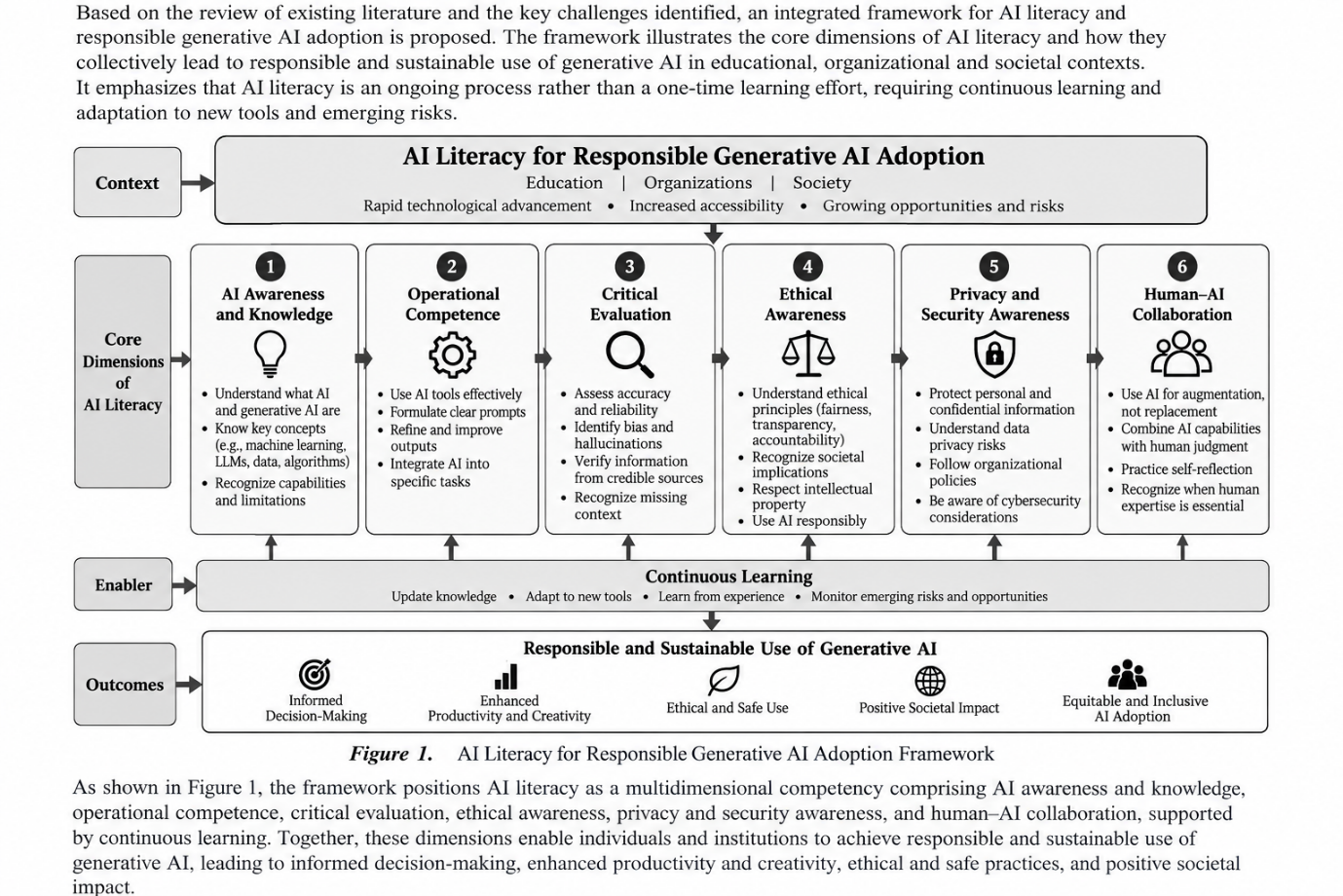
Figure 1. AI Literacy for Responsible Generative AI Adoption Framework
As illustrated in Figure 1, responsible generative AI adoption depends on the development of multiple complementary competencies. AI awareness and knowledge provide the foundation for understanding AI capabilities, applications and limitations, while operational competence enables users to interact effectively with AI tools and integrate them into relevant tasks. Critical evaluation helps users assess the accuracy, reliability and potential bias of AI-generated outputs and encourages verification through credible sources. Ethical awareness promotes fairness, transparency, accountability and responsible decision-making, whereas privacy and security awareness helps users recognize data-related risks and protect personal and organizational information. Human–AI collaboration emphasizes the importance of using AI to augment human capabilities rather than replacing human judgment, particularly in situations requiring expertise, contextual understanding and ethical reasoning.
These dimensions are supported by continuous learning, which enables individuals and organizations to update their knowledge, adapt to emerging AI tools and respond to new risks and opportunities. Collectively, the dimensions contribute to informed decision-making, enhanced productivity and creativity, ethical and safe AI practices, positive societal impact and more equitable adoption of generative AI.
The framework is consistent with the multidimensional approaches to AI literacy proposed by Long and Magerko (2020), Almatrafi et al. (2024), Pinski and Benlian (2024), Lintner (2024) and Chiu et al. (2024). However, the proposed framework extends these perspectives by explicitly connecting AI literacy competencies with the responsible adoption and use of generative AI across educational, organizational and societal contexts. It therefore positions AI literacy not merely as the ability to understand or operate AI technologies, but as a broader competency involving knowledge, skills, critical judgment, ethical awareness, security consciousness and meaningful human–AI collaboration.
7. Implications for Education, Organizations and Society
For higher education, AI literacy should become part of broader digital competency development. Students should learn not merely how to use GenAI for assignments but how to verify information, acknowledge AI assistance, protect personal information and make ethical decisions.
For organizations, AI literacy programs should combine technical training with ethical, privacy and security awareness. Employees should understand both the opportunities and limitations of AI within their specific roles. Organizations should also provide clear policies regarding acceptable AI use.
For society, AI literacy can contribute to more informed participation in an increasingly AI-mediated environment. Public awareness initiatives can reduce misinformation, improve trust and help individuals make better decisions about AI-enabled services.
AI literacy should therefore be considered a lifelong competency, rather than an isolated educational subject.
8. Future Directions
Future research should focus on developing reliable and context-sensitive instruments for measuring AI literacy. Lintner (2024) demonstrates that although several AI literacy scales exist, important measurement gaps remain.
Research should also investigate AI literacy across different demographic, educational and occupational groups. Comparative studies could examine whether the competencies required by students differ from those required by employees, managers or entrepreneurs.
Another important area is the relationship between AI literacy and actual responsible behaviour. Possessing AI knowledge does not automatically guarantee ethical use. Future studies should therefore examine how AI literacy translates into real-world decision-making.
Finally, as GenAI becomes increasingly embedded in organizations and education, research should explore the relationship between AI literacy, productivity, trust, well-being, employability and sustainable digital transformation.
9. Conclusion
Generative AI is transforming how individuals learn, work, communicate and make decisions. However, responsible adoption cannot be achieved simply by increasing access to AI tools. Individuals require the knowledge, skills and judgment necessary to understand AI capabilities, evaluate its outputs and recognize its ethical, privacy and societal implications.
This chapter conceptualized AI literacy as a multidimensional competency involving AI knowledge, operational competence, critical evaluation, ethical awareness, privacy and security awareness, and human–AI collaboration. The proposed framework emphasizes that responsible GenAI use depends on the interaction of these competencies and on continuous learning.
AI literacy should consequently become an essential component of digital capability development in education, organizations and society. The objective should not be to encourage people to use AI indiscriminately, but to enable them to use AI effectively, critically, ethically and responsibly while retaining meaningful human judgment.
References
Almatrafi, O., Johri, A., & Lee, H. (2024). A systematic review of AI literacy conceptualization, constructs, and implementation and assessment efforts (2019–2023). Computers and Education Open, 6, 100173. https://doi.org/10.1016/j.caeo.2024.100173
Bender, E. M., Gebru, T., McMillan-Major, A., & Shmitchell, S. (2021). On the dangers of stochastic parrots: Can language models be too big? Proceedings of the 2021 ACM Conference on Fairness, Accountability, and Transparency, 610–623. https://doi.org/10.1145/3442188.3445922
Chiu, K. F., Ahmad, Z., Ismailov, M., & Sanusi, I. T. (2024). What are artificial intelligence literacy and competency? A comprehensive framework to support them. Computers and Education Open, 6, 100171. https://doi.org/10.1016/j.caeo.2024.100171
Dwivedi, Y. K., Kshetri, N., Hughes, L., Slade, E. L., Jeyaraj, A., Kar, A. K., Baabdullah, A. M., Koohang, A., Raghavan, V., Ahuja, M., Albanna, H., Albashrawi, M. A., Al-Busaidi, K. A., Balakrishnan, J., Barlette, Y., Basu, S., Bose, I., Brooks, L., Buhalis, D., … Wright, R. (2023). “So what if ChatGPT wrote it?” Multidisciplinary perspectives on opportunities, challenges and implications of generative conversational AI for research, practice and policy. International Journal of Information Management, 71, 102642. https://doi.org/10.1016/j.ijinfomgt.2023.102642
European Commission. (2019). Ethics guidelines for trustworthy AI. High-Level Expert Group on Artificial Intelligence.
Floridi, L., Cowls, J., Beltrametti, M., Chatila, R., Chazerand, P., Dignum, V., Luetge, C., Madelin, R., Pagallo, U., Rossi, F., Schafer, B., Valcke, P., & Vayena, E. (2018). AI4People—An ethical framework for a good AI society: Opportunities, risks, principles, and recommendations. Minds and Machines, 28, 689–707. https://doi.org/10.1007/s11023-018-9482-5
Grover, D., & Vats, S. (2026). A critical review of artificial intelligence and its influence on organisational work practices and culture. New Horizons of Science, Technology and Culture, 11, 27–47. https://doi.org/10.9734/bpi/nhstc/v11/7563
Jobin, A., Ienca, M., & Vayena, E. (2019). The global landscape of AI ethics guidelines. Nature Machine Intelligence, 1, 389–399. https://doi.org/10.1038/s42256-019-0088-2
Kasneci, E., Sessler, K., Küchemann, S., Bannert, M., Dementieva, D., Fischer, F., Gasser, U., Groh, G., Günnemann, S., Hüllermeier, E., Krusche, S., Kutyniok, G., Michaeli, T., Nerdel, C., Pfeiffer, F., Poquet, O., Sailer, M., Schmidt, A., Seidel, T., … Kasneci, G. (2023). ChatGPT for good? On opportunities and challenges of large language models for education. Learning and Individual Differences, 103, 102274. https://doi.org/10.1016/j.lindif.2023.102274
Lintner, T. (2024). A systematic review of AI literacy scales. npj Science of Learning, 9, 50. https://doi.org/10.1038/s41539-024-00264-4
Long, D., & Magerko, B. (2020). What is AI literacy? Competencies and design considerations. Proceedings of the 2020 CHI Conference on Human Factors in Computing Systems, 1–16. https://doi.org/10.1145/3313831.3376727
OECD. (2019). Recommendation of the Council on Artificial Intelligence. OECD.
Pinski, M., & Benlian, A. (2024). AI literacy for users—A comprehensive review and future research directions of learning methods, components, and effects. Computers in Human Behavior: Artificial Humans, 2(1), 100062. https://doi.org/10.1016/j.chbah.2024.100062
UNESCO. (2021). Recommendation on the ethics of artificial intelligence. UNESCO.
Vats, S., & Sharma, M. (2025). Harnessing artificial intelligence to advance green education: Perceptions, challenges, and implementation insights. European Economic Letters, 15(2), 2932–2941.
Vats, S., & Sharma, M. (2026). A multilevel review of artificial intelligence and employee well-being in organizations. Journal of Marketing & Social Research, 3(1), 207–221.
Yim, I. H. Y. (2024). A critical review of teaching and learning artificial intelligence (AI) literacy: Developing an intelligence-based AI literacy framework for primary school education. Computers and Education: Artificial Intelligence, 7, 100319. https://doi.org/10.1016/j.caeai.2024.100319
Yusuf, A., Pervin, N., Román-González, M., & Noor, N. M. (2024). Generative AI in education and research: A systematic mapping review. Review of Education, 12(2), e3489. https://doi.org/10.1002/rev3.3489
Get an email when we publish new research and open calls for chapters.
Create a free account