
Chapter 54
III.Methodology
- ISBN
- 978-81-992602-2-0
- Published
- 21 July 2026
- Accesses
- 60 views · 0 downloads
- Reading time
- ~17 min
Full text
B
Iot Based Smart Trolley With Integrated Human Tracking
| |||||
|---|---|---|---|---|---|
Abstract -In metro cities we see a huge rush in shopping markets. Huge offers and discounts attract more crowd to the markets. Normally, in shopping malls we get a trolley in which we put all the items that we want to purchase from the shelves. Sometimes the trolley gets too heavy, then we have to put in a lot of effort to pull the trolley. Also, we approach the counter for billing, and we have to wait for a long time in queues. This project presents a solution for this. The trolley follows the human through the ultrasonic sensor and the image processing, which reduces the efforts of pulling the trolley. For solving the problem of long queues at the counters, an RFID reader that scans the barcode and automatically detects the product when we put it in the trolley. The total price and quantity can be directly seen on the webpage through the mobile phone.By this practice, the trolley will itself do all billing, and problem of long queue on the counters will be solved.
Keywords — Autonomous trolley, Automated billing, RFID, Human-following robot, Smart retail system.
-
INTRODUCTION
The development of retail infrastructure at a rapid pace and the rising demands of customers have triggered a higher demand for automation in shopping centers.The existing supermarket model requires customers to push carts themselves, search for the items they need, stand in long queues for billing, and rely entirely on human-operated billing counter services. Standing in long lines is a total waste of time. This results in inefficiencies at shopping centers due to the manual system adopted. New developments in the field of embedded systems, the Internet of Things (IoT), and automation technology have triggered the development of smarter solutions for the retail sector. Many approaches have been proposed for automated billing systems and smarter navigation systems to eliminate the need for human intervention while shopping. However, these approaches mostly focus on either automated billing or autonomous navigation, rarely integrating both into a single system.
With a view to overcoming such limitations, this paper suggests the AutoBill Cart, an intelligent and self-driving cart with integrated RFID-based billing and a customer-tracking navigation system. The RFID reader scans the barcode and automatically detects the product when we put it in the trolley. The total price and quantity can be directly seen on the webpage through the mobile phone.By this practice, the trolley will itself do all billing, and problem of long queue on the counters will be solved. Additionally, the trolley has ultrasonic , IR sensors and image processing for customer tracking. The trolley is operated using an Arduino Uno microcontroller that oversees all processes, from sensor data analysis to motor control and payment calculation. The proposed system improves customer efficiency and convenience by eliminating payment queues and reducing reliance on human intervention. The AutoBill Cart demonstrates that integrating embedded systems, automation, and retail solutions can provide a foundation for future automated retail infrastructure.
II. LITERATURE REVIEW
[1] Finkenzeller’s work provides a comprehensive foundation of RFID technology, covering operating principles, tag-reader communication, frequency standards, and real-world applications. The book explains passive and active RFID systems, anti-collision protocols, and deployment challenges in commercial environments. This reference serves as the theoretical backbone for understanding RFID-based product identification used in the automated billing module of the proposed smart trolley. However, the book does not focus on the integration of RFID with autonomous mobile platforms or real-time billing systems in retail environments.
[2] Gaddam et al. proposed an RFID-enabled shopping system that automates billing by identifying products placed in a cart. Their system focuses on reducing checkout time by eliminating barcode scanning and manual billing. However, the study does not address trolley mobility or customer-following functionality. The proposed AutoBill Cart extends this work by integrating autonomous navigation along with RFID-based billing. The system makes billing faster and easier, but the trolley still needs to be stationary or manually pushed by the customer.
[3] This book presents fundamental concepts of autonomous mobile robotics, including kinematics, sensors, motion control, and navigation strategies. It provides theoretical insights into obstacle avoidance, sensor-based decision-making, and motor control algorithms. These concepts form the basis for designing the human-following and obstacle avoidance subsystem in the smart trolley. These ideas make it easier to design a trolley that can safely follow a customer without sudden movements.
[4] Thrun discusses the societal impact of intelligent robotic systems and highlights their applications in daily life, including service robots and automation in public spaces. The paper emphasizes the importance of safe human-robot interaction, which aligns with the design philosophy of the AutoBill Cart that follows customers safely in a retail environment. This supports the idea of using robots in public places like supermarkets, where safety and trust are important.
[5] Roy et al. presented a smart shopping cart that uses RFID and IoT technologies to automate billing and transmit purchase data to a central server. While effective in reducing manual effort, their system primarily focuses on billing and inventory updates. The proposed system enhances this concept by adding human-following navigation and on-device web-based bill display. However, customers still need to handle the trolley themselves, which leaves room for further improvement.
[6] This work introduced an RFID-based trolley designed to automate billing and reduce checkout delays. The system demonstrates improved billing efficiency but lacks mobility and customer interaction features. The AutoBill Cart builds upon this research by incorporating autonomous movement and real-time user feedback through a web interface. This approach proves that automated billing can save time and reduce long queues.
[7] Verdouw et al. explored IoT-enabled digital twins for product tracking and inventory management in retail environments. Their work highlights the importance of real-time data synchronization between physical products and digital systems. This research supports the concept of real-time billing and inventory updates implemented in the proposed system. This also ensures that customers receive correct and updated billing information instantly.
[8] Ahmad and Khan designed a human-following robot using ultrasonic and infrared sensors for distance and direction tracking. Their approach demonstrates effective low-cost human-following without vision-based systems. This research directly influences the navigation strategy used in the AutoBill Cart’s human-following subsystem. The use of simple sensors makes the system affordable and easy to implement
[9] Silva et al. discussed IoT-driven smart supermarket environments aimed at improving customer experience and operational efficiency. The paper emphasizes automation, connectivity, and real-time data processing, reinforcing the motivation for integrating IoT-based billing and monitoring in smart trolleys. Smart supermarkets aim to make shopping faster, easier, and more comfortable for customers.
[10] This research proposed an IoT-based architecture using ESP32 and RFID for contactless shopping and centralized billing. Their system highlights the advantages of ESP32 in handling wireless communication and real-time data processing. This directly supports the choice of ESP32 for hosting the web-based billing interface in the AutoBill Cart. Using ESP32 helps in maintaining fast and reliable communication between the trolley and the billing system.
[11] Chakraborty and Gadekar presented a human-tracking robot using IR and ultrasonic sensors combined with PID-based navigation. Their study demonstrates reliable tracking in indoor environments. The AutoBill Cart adopts a simplified version of this approach for stable and smooth customer-following movement. The navigation method helps the robot follow a person smoothly without frequent stops or jerks.
[12] Al-Karaki reviewed the role of autonomous robotic systems in retail automation, focusing on navigation, customer interaction, and system integration challenges. The study identifies smart trolleys as a key future technology, validating the relevance and applicability of the proposed AutoBill Cart. Τηε στυδψ εξπλαινσ ωηψ αυτοματιον ισ βεχομινγ νεχεσσαρψ ιν μοδερν ρεταιλ στορεσ.
[13] This paper discusses secure and scalable RFID middleware for inventory management systems. It highlights challenges such as data consistency and scalability in RFID deployments. These insights are relevant for extending the AutoBill Cart to large-scale retail inventory systems. These concepts can help scale the AutoBill Cart system to larger supermarkets.
[14] Gupta and Jain investigated sensor fusion techniques for obstacle avoidance and target tracking in indoor robots. Their work emphasizes combining multiple sensor inputs to improve reliability. Although the AutoBill Cart uses simpler sensor logic, this study provides a pathway for future enhancements using sensor fusion. This shows how future versions of the AutoBill Cart can become more intelligent and reliable
[15] Park et al. proposed an IoT-based smart retail intelligence framework for real-time product identification and customer analytics. Their research demonstrates how IoT systems can transform retail operations. The AutoBill Cart aligns with this vision by providing automated billing and customer-friendly shopping assistance.
III.Methodology
- System overview
The proposed system is an autonomous shopping trolley that follows a human, integrated with an automated billing mechanism. It is designed to track the user using computer vision and sensor fusion while managing item detection and billing.
B.Components
- Arduino Uno
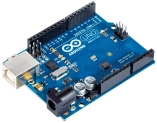
fig.1
Main controller: Arduino Uno- ATmega328P microprocessor. This is equipped with 14 digital I / O pins, six PWM outputs, and six analog input channels. Hence, it can be easily interfaced with several sensors and actuators at the same time. It operates on 5 volts at a clock frequency of 16 MHz. Arduino processes data from ultrasonic and infrared sensors for real-time decisions in controlling the movement. It also generates PWM signals to the L298N motor driver that drives trolley motors and orients the trolley in a specific path during autonomous mode.
- ESP32
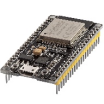 fig.2
fig.2
The ESP32 microcontroller handles the automated billing system and acts as the Wi-Fi-enabled platform for the project. It has a dual-core 32-bit processor running at 240 MHz and comes with built-in Wi-Fi and Bluetooth. This allows the ESP32 to communicate wirelessly and host a web page for billing. Operating at 3.3 volts, it connects to the MFRC522 RFID module using the SPI protocol. When a product is scanned, the ESP32 reads its ID, updates the bill in real time, and displays it on an HTML page that can be accessed from any mobile phone or browser connected to the same network.
- RFID Reader (MFRC522)
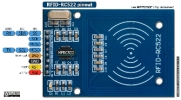 fig.3
fig.3
The MFRC522 RFID module enables the contactless identification of products placed inside the trolley. Operating at the standard RFID frequency of 13.56 MHz, it detects passive RFID tags within a reading distance of 2 to 6 cm. The module communicates via SPI through SDA, SCK, MOSI, MISO, and RST pins, enabling fast and reliable tag recognition. When an RFID-tagged product is scanned, the reader transmits the unique ID to the ESP32 for authentication, billing, and total amount calculation.
- Ultrasonic Sensor (HC-SR04)
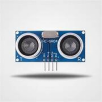 fig.4
fig.4
- The HC-SR04 ultrasonic sensor is used in the navigation system to help the trolley avoid obstacles. It sends out high-frequency sound pulses and measures the time it takes for the sound to bounce back. This lets the sensor calculate the distance to objects, which can range from 2 cm to 400 cm with an accuracy of about ±3 mm. Powered at 5 volts, the sensor connects to the Arduino through the TRIG and ECHO pins and constantly monitors the environment. If an obstacle is detected within the set safe distance, the Arduino stops the trolley immediately to prevent a collision.
- Infrared Sensors
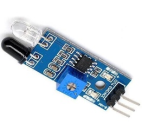 fig.5
fig.5
A pair of infrared reflective sensors is used for human tracking and directional guidance. These sensors detect reflected IR light from the customer's legs or lower body, outputting digital logic signals that indicate the subject’s direction relative to the trolley. Operating at 5 volts, the right and left IR sensors allow the Arduino to determine whether to move forward or turn right or turn left. This enables smooth following motion while maintaining user alignment and safety.
- L298N Motor Driver
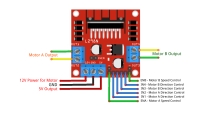 fig.6
fig.6
The L298N dual H-bridge motor driver amplifies control signals from the Arduino to operate the high-current DC gear motors. It supports input voltages between 5 and 35 volts and outputs up to 2 amperes per channel, making it suitable for robust trolley movement under varying payloads. The driver receives PWM speed commands and directional logic inputs from Arduino to regulate the wheel motors during turns, forward movement, and stopping.
- DC Gear Motors
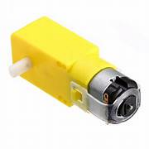 fig.7
fig.7
The trolley uses four high-torque DC gear motors to achieve stable motion and load-bearing capability. Operated between 6 and 12 volts, these motors provide adequate power to move the trolley smoothly even when filled with groceries. The gear reductions increase torque and allow precise low-speed control, which is essential for indoor autonomous applications.
- Power Supply Unit
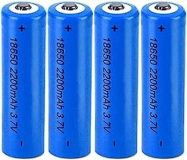 fig.8
fig.8
The power system consists of a 7–12-volt rechargeable battery that supplies energy to the L298N motor driver and consequently, to the motors. The Arduino Uno is powered through its VIN pin, while the ESP32 receives regulated power from a 5-volt USB supply or battery module. A shared ground reference across all modules ensures stable electrical performance and noise-free operation during simultaneous motor control and sensor communication.
C.Algorithm
I.The trolley is created by integrating smart navigation and billing simultaneously. The development process is step-by-step: the first step is the linking of the sensors/actuators to the Arduino, the second step is the design of the smart navigation and billing algorithm, and the third is the integration to create the smart trolley.
II. The RFID reader detects items inserted into the cart and transmits unique tag IDs. The Arduino Uno uses a lookup table to identify corresponding product names and prices. The billing system displays the running total via the website. Concurrently, the navigating system operates as follows. The ultrasonic sensor acts as a preventive measure against collision by stopping the cart. The dual IR sensors monitor the customer, and their outputs are sent as corrective signals for the motor driver so smooth movement can occur.
III.Drive speed and turning are adjusted by means of a PWM signal through the L298N controller to enable smooth motion or turning even while the trolley is loaded. This enables a trolley to roll and at the same time process billing in real time to facilitate faster online shopping.
D.Pseudo code
The AutoBill Cart thus performs both sequential and parallel operations corresponding to billing and the movement. The pseudo code starts by initializing all components and then entering into a continuous loop. Items are scanned through an RFID reader. The pseudo code checks if a valid ID has appeared. If yes, then it adds the price of the product to the total bill, which is then instantly displayed on the website. Simultaneously, the item ensures proper scanning with a servo locking mechanism.
The movement logic runs parallel to the billing. It constantly checks via the ultrasonic sensor for the obstacle, stops the trolley if the approach is too near, and IR sensors guide the trolley to move straight, turn left, or turn right for following the customer.
IV.Results and Discussions
The AutoBill Cart was also successfully tested in terms of its usage as well as its billing system, and it worked perfectly in terms of its operation. The use of the RFID system proved to have been successful in terms of scanning the objects in the cart without any errors after performing the trials involving the addition/removal of objects, and the total bill was also displayed in real time on the webpage. The cart also followed the user successfully on its path, straight as well as cleared around bends, while keeping at a safe distance at all times. It also avoided the crowds at congested areas as intended by the servo locks. It worked perfectly in terms of its usage as required.
One simple and effective method for more accuracy with different types of billing scenarios is the incorporation of a smart system with Arduino and RFID tags. With this method, RFID tags can be designed and attached to each product. The Arduino system will then read each tag as the product is added to the cart. Although this method may require each client to have their own tag, they will also have access to their own payment method.
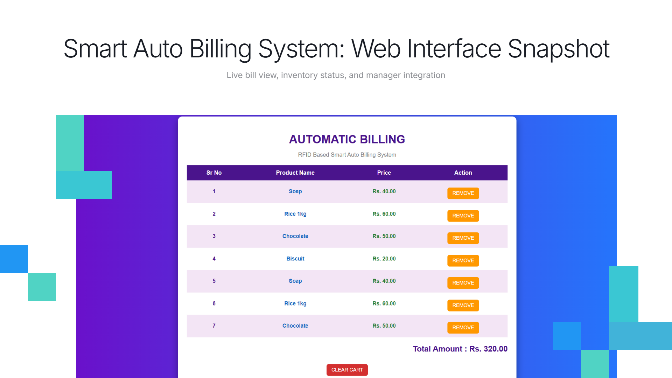
Fig.9 Result displayed on the webpage Advantages of the Smart Billing System:
1. Shorter queues: Customers are able to pay faster with minimized queues.
2. Improved accuracy: The scope for human errors in the course of billing
3. Increased efficiency: The transactions are done in real-time, making them easier
4. Reduced costs: Organizations can reduce labor costs to maximize profits.
5. User-friendly: It is easy to install and use the device, and the Arduino and RFID components are relatively cheaper yet efficient enough for all businesses, small or big.
Example of Use in a Retail Store:
1. All products have RFID tags to integrate tracking information.
2. The customer is provided with an RFID card upon their entry.
3. The Arduino, which contains RFID readers, scans every object as it enters the shopping cart.
4. The system can recognize items and also revise the bill real-time.
5. At the end of the shopping process, the customer shall use their RFID card at check out.
6. The Arduino will compute the total and render it on the screen.
7. The customer makes a payment according to their selected form of payment.
8. this intelligent billing system has flexibility in its implementation with minimal maintenance needs. The business may also employ SCRM (Supply Chain Relation Management) strategies to enhance its services or reduce cost and improve profitability.
V.Future Scope
The existing smart retail space, i.e., the "AutoBill Cart," can be improved even further to create a complete "self-driving" smart retail space, where a mobile application can enable users to monitor their bills in real time, pay bills online, and even store bill history records online. There can be cloud-based management of the items in the store, enabling auto-updates of stock levels, including notifications of stock requirements.
Future versions may employ computer vision technology in place of IR sensors for human tracking and obstacle avoidance. The use of computer vision products may even lead to a completely non-RFID system for customer transactions. Li-Fi or GPS positioning in conjunction with wireless charging and auto-parking may enhance the intelligence and commercial viability of the proposed system designed for indoor locations.
VI.Conclusion
The AutoBill Cart successfully combines autonomous movement with automated billing in a single embedded system. It features human-following mobility, real-time billing through RFID, price displays on an LCD, and secure locking mechanisms. These features eliminate the need for barcode scanning and reduce queues at supermarket checkout counters.
VII.Acknowledgment
The authors sincerely thank the project supervisor, laboratory staff, and institution for their support, facilities, and encouragement throughout the development of this project.
References
- K. Finkenzeller, RFID : Fundamentals and Applications in Contactless Smart Cards and Identification, Wiley, 2010.
- A. Gaddam et al., “Smart shopping systems using RFID,” IEEE Systems Journal, vol. 7, no. 4, pp. 1–10, 2018.
- R. Siegwart and I. Nourbakhsh, Introduction to Autonomous Mobile Robots, MIT Press, 2011.
- S. Thrun, “Robotics and intelligent systems in support of society,” IEEE Robotics & Automation Magazine, 2018.
- A. Roy, S. Roy, and S. Nandi, “Smart shopping cart for automated billing using RFID and IoT,” IEEE International Conference on Inventive Systems and Control (ICISC), pp. 1–6, 2018.
- M. F. Wani, R. R. Jadhav, and A. T. Jadhav, “RFID based automatic billing trolley,” International Journal of Advanced Research in Electrical, Electronics and Instrumentation Engineering, vol. 4, no. 4, pp. 2304–2311, 2015.
- S. Verdouw et al., “Digital twins in smart retail: IoT-based product identification and tracking,” Computers in Industry, vol. 134, pp. 103–118, 2022.
- A. Ahmad and M. Khan, “Design and implementation of autonomous human-following robot using ultrasonic and infrared sensors,” IEEE 10th International Conference on Robotics and Artificial Intelligence (ICRAI), pp. 65–70, 2020.
- B. N. Silva, M. Khan, and K. Han, “Internet of Things based smart environments for supermarkets,” IEEE Access, vol. 7, pp. 8156–8170, 2019.
- T. P. Singh, P. Sharma, and A. Arora, “RFID and ESP32 based IoT architecture for contactless shopping and centralized billing,” International Conference on Smart Computing and Networking (ICSCN), pp. 112–118, 2021.
- D. Chakraborty and P. Gadekar, “Human tracking mobile robot using IR and ultrasonic sensors with PID-based navigation,” International Journal of Robotics and Automation, vol. 9, no. 2, pp. 44–49, 2020.
- A. Al-Karaki, “Autonomous robotic systems in retail automation: A review,” IEEE Transactions on Automation Science and Engineering, vol. 18, no. 3, pp. 1254–1267, 2021.
- S. K. Mondal and B. Gupta, “RFID middleware for secure and scalable inventory management systems,” IEEE Systems Journal, vol. 14, no. 4, pp. 5043–5053, 2020.
- Y. Gupta and R. Jain, “Sensor fusion for obstacle avoidance and target tracking in indoor autonomous robots,” IEEE Sensors Journal, vol. 21, no. 22, pp. 25489–25497, 2021.
- J. H. Park et al., “Smart retail intelligence using IoT-based real-time product identification and customer analytics,” IEEE Internet of Things Journal, vol. 9, no. 8, pp. 6031–6044, 2022.
Get an email when we publish new research and open calls for chapters.
Create a free account