
Chapter 18
IMPACT OF EMPLOYEE EMPOWERMENT ON PROFITABILITY WITH SPECIAL REFERENCE TO HCL
- ISBN
- 978-81-963834-0-4
- Published
- 26 July 2026
- Accesses
- 32 views · 47 downloads
- Reading time
- ~13 min
Full text
IMPACT OF EMPLOYEE EMPOWERMENT ON PROFITABILITY WITH SPECIAL REFERENCE TO HCL
SRI RAMYA REDDY, MEGHNA SAIKIA, AAKSHAYA MANIVANNAN
IFIM College , Bangalore
Dr.SWARNIKA DIXIT
Assistant Professor, HOD-BBA, IFIM College, Bangalore
Abstract
HCL Technologies is a leading worldwide technology company that aids businesses in reimagining their industries for the digital era. With a world-renowned management philosophy, a strong culture of creativity and risk-taking, and a relentless focus on customer interactions, our technology products, services, and engineering are built on four decades of innovation. With the help of our Mode 1-2-3 approach, which is based on a number of different technologies including Digital, IoT, Cloud, Automation, Cybersecurity, Analytics, Infrastructure Management, and Engineering Services, we provide an integrated portfolio of goods, services, solutions, and IP. HCL services major businesses across critical industries, including 250 of the Fortune 500 and 650 of the Global 2000, with a global network of R&D, innovation laboratories, and delivery centres and 210,966 "Ideapreneurs" working in 52 countries. HCL technologies are pioneering new forms of management and internal practices that truly do put the employee first. Their website is filled with interesting information about their culture of ‘ideapreneurship ‘which puts employees at the forefront of innovation, their employee-centric mission statement, and their reverse management style. Transparency & integrity are the most important values to HCL Technologies employees and because of this 50% of employees are proud to be part of HCL Technologies.
Keywords: Employee, empowerment, profitability, next-generation, global technology, automation.
Introduction
HCL Technologies is a next-generation global technology company that helps enterprises reimagine their businesses for the digital age. Our technology products and services are built on four decades of innovation, with a world-renowned management philosophy, a strong culture of invention and risk-taking, and a relentless focus on customer relationships. HCL also takes pride in its many diversities, social responsibility, sustainability, and education initiatives. Through its worldwide network of R&D facilities and co-innovation labs, global delivery capabilities, and over 197,000+ ‘Ideas across 52 countries, HCL delivers holistic services across industry verticals to leading enterprises, including 250 of the Fortune 500 and 650 of the Global 2000. The company’s DNA of grassroots innovation, its ingrained culture of co-innovation, and its tradition of going far beyond what is expected, to create customer value, clearly differentiates it and gives it a distinct advantage in creating value for businesses in the digital and connected world Employee
empowerment is defined as how organizations provide their employees with a certain degree of autonomy and control in their day-to-day activities. A key principle of employee empowerment is providing employees the means for making important decisions and helping ensure those decisions are correct. It’s great for boosting creativity, less so for improving routine performance. Research has regularly demonstrated that when employees feel empowered at work, it is associated with stronger job performance, job satisfaction, and commitment to the organization. One of the most basic employee empowerment examples is simply giving employees a voice in important decisions that could affect them. According to one study, 74% of managers surveyed felt that employee input was “very” or “somewhat” effective at improving decision-making processes. A leading worldwide technology corporation, HCL Technologies assists organizations in reimagining their operations for the digital era. Our engineering, technology products, and services are based on four decades of innovation, a well-known management philosophy, a vibrant innovation and risk-taking culture, and an unwavering commitment to our clients' needs.
Through our Mode 1-2-3 strategy, which is based on Digital, IoT, Cloud, Automation, Cybersecurity, Analytics, Infrastructure Management, and Engineering Services, among other things, we provide an integrated portfolio of products, solutions, services, and IP. With 250 of the Fortune 500 and 650 of the Global 2000, as well as a global network of R&D, innovation labs, and delivery centres spread across 52 countries, HCL services top businesses in a variety of important industries.
Objective
To understand the impact of employee empowerment on profitability.
Literature review
Major approaches for empowerment
Employee first customer second Today’s youth work very differently to anything we’ve seen before. They are natural collaborators, communicators, innovators. We just need to give them the tools they need and get out of their way. ( Gurteen, D. ,1998). The EFCS Transformation HCL implemented a four-phase transformation for its “Employees First” journey. These were: Mirror Mirror, Confronting the Truth Using Transparency to Build Trust Inverting the Management Pyramid Recasting the Office of the CEO To shift thinking and create real, sustainable change during this process, HCLT used many small catalysts that set the journey in motion. HCLT experimented with various practices throughout the “Employees First” journey. While many of these practices worked for HCLT, the small catalysts that create big changes may be different in other companies, industries, and cultures. Experimentation is encouraged. (Nayar, V.,2010).
Mirror Mirror, Confronting the Truth To create the need for change, HCLT needed to establish Point A—the reality of their business situation. Open, honest conversations unveiled the truth and created the need for change. At the same time, HCLT worked to establish a vision of the future, a Point B, that inspired and motivated people with the romance of tomorrow. (Daft, R.
L.,2014). Using Transparency to Build Trust To build the trust needed to enact change, HCLT threw open the windows of transparency and shared the company’s financial information— the good as well as the bad—with employees across groups. By pushing the envelope of transparen HCLT built trust between management and employees. That trust led to employee-initiated action.Inverting the Management Pyramid HCLT turned the traditional organizational structure upside down and made managers and those in enabling functions—such as HR and finance—accountable to the frontline employees who work in the value zone, just as those employees were accountable to their managers. These structural changes made long-term, sustainable change possible. (Wayne Boss, R., Dunford, B. B., Boss, A. D., & McConkie, M. L.,2010).
Inverting the Management Pyramid- Open 360-degree Review To help invert the organizational pyramid, HCLT opened the 360-degree performance review process to all employees who a manager might influence— and allowed anyone who had given a manager feedback access to the results of that manager’s 360. This practice increased participation, empowered employees, and made the 360 review a development tool, not an evaluative one. (London, M., & Beatty, R. W.,1993). 360-degree feedback as a competitive advantage. Human Resource Management, 32(2-3), 353-372. Ideapreneurship is the self-sustaining, self-inspired, innovation engine that drives HCL forward.HCL firmly believes in ideapreneurship – a unique culture of grass-roots, business-driven, customer-focused innovation, in which every employee has a license to ideate. It empowers and encourages individual employees at all levels of the organization to come up with innovative solutions to customers’ business challenges. These inspired employees to think of new ideas and take them to fruition.This vibrant entrepreneurial culture is powered by HCL’s ‘Employees First’ values, which has given rise to institutional and grass-root programs that help seed ideas, mentor creativity, and harvest innovation. (Tenywa, M. M., Rao, K. P. C.,2011)
Innovations leading to employee empowerment
Recasting the Office of the CEO: HCLT transferred the responsibility for change from the office of the CEO to the employees, creating a company that was, in many ways, self-run and self-governing. Employees now ask and answer as many questions as the CEO, increasing the speed and quality of innovation and decision-making in the value zone.
Ticketing system An employee at any level who disagrees with their manager or feels they have been treated unfairly, or feels that an internal department is not living up to its standards can fill out a ticket on the ‘offender’. Tickets are visible to the whole organization, and they can only be closed by the employee. So, until such time that the employee feels that the issue has been resolved, the ticket remains open. Any ticket not closed in 24 hours gets escalated to the next level of management – Well hello, no leaving unresolved issues by the wayside nor dusting them under the rug with this system. (Chappell, P.,2013).
The Value Portal To help recast the role of the CEO and transfer responsibility from senior management to the company, HCLT launched the Value Portal—a system that enables employees to offer suggestions and solutions for change. To date, it has led to more than 500 ideas that HCLT has implemented, creating more than $25 million in value.
Smart Service Desk Smart Service Desk (SSD) is a system HCLT created to resolve problems between the enabling functions and the frontline employees. Any employee with a problem can open a trouble ticket, which is assigned to a manager responsible for its resolution. Since only the
employee who opened the ticket can sign off on the solution, SSD helped address and resolve thousands of longstanding problems. (Helps, Y., Moller, J., Kowanko, I., 2008)
Inspire – An advocacy program recognizing that workplaces of the future will be employee-led and will drive culture as a top-down activity, HCL Technologies has put in place ‘Inspire’ – an advocacy program that employs a multi-level engagement approach to drive employee awareness and adoption of various internal platforms. (Bocken, N. M., & Geradts, T. H. ,2020)
At the Noida headquarters, employees generate ideas that are customer-centric and are linked to the business strategy, which in turn add value for customers. ‘Inspire’ directly work with the people managers community who are accountable for engaging their teams, thereby creating a grassroots movement with higher and faster reach.( Bradley, A. J., & McDonald, M. P. 2011)
Analysis
Hcl technologies distribution of revenues by service offering/verticals / contract type (2008-2013)
|
Service Offering Mix |
30-Jun- 08 |
30-Jun- 09 |
30-Jun- 10 |
30-Jun- 11 |
30-Jun- 12 |
30-Jun- 13 |
|---|---|---|---|---|---|---|
|
Enterprise Application Services |
10.8% |
23.6% |
22.2% |
20.9% |
20.8% |
17.7% |
|
Engineering and R&D Services |
26.7% |
19.4% |
19.6% |
17.8% |
18.6% |
17.3% |
|
Custom Application Services |
36.1% |
29.7% |
29.6% |
31.8% |
31.3% |
29.2% |
|
Infrastructure Services |
15.2% |
17.6% |
22.4% |
24.5% |
24.8% |
31.5% |
|
BPO Services |
11.2% |
9.7% |
6.2% |
4.9% |
4.4% |
4.3% |
|
Revenue by Vertical |
30-Jun- 08 |
30-Jun- 09 |
30-Jun- 10 |
30-Jun- 11 |
30-Jun- 12 |
30-Jun- 13 |
|---|---|---|---|---|---|---|
|
Financial Services |
27.3% |
24.8% |
24.9% |
26.0% |
23.8% |
25.3% |
|
Manufacturing |
30.6% |
30.9% |
27.3% |
28.0% |
28.4% |
28.8% |
|
Telecom |
16.0% |
12.5% |
10.9% |
9.1% |
8.0% |
7.3% |
|
Retail &CPG |
8.8% |
6.6% |
8.2% |
7.9% |
8.6% |
8.6% |
|
Media, Publishing &Entertainment |
5.6% |
5.6% |
7.4% |
7.1% |
6.7% |
6.7% |
|
Life sciences & Healthcare |
5.7% |
6.4% |
8.2% |
7.9% |
10.8% |
11.3% |
|
Public Services |
1.5% |
7.6% |
6.9% |
8.3% |
7.2% |
8.0% |
|
Others |
4.5% |
5.6% |
6.2% |
5.7% |
6.4% |
4.0% |
|
Revenue by ContractType for IT Services |
30-Jun- 08 |
30-Jun- 09 |
30-Jun- 10 |
30-Jun- 11 |
30-Jun- 12 |
30-Jun- 13 |
|---|---|---|---|---|---|---|
|
Time & Material |
65.0% |
61.5% |
59.1% |
57.5% |
49.2% |
47.8% |
|
FPP/Managed Services |
35.0% |
38.5% |
40.9% |
42.5% |
50.8% |
52.2% |
|
Client Data (LTM) |
30-Jun-08 |
30-Jun-09 |
30-Jun-10 |
30-Jun- 11 |
30-Jun- 12 |
30-Jun- 13 |
|---|---|---|---|---|---|---|
|
Number of Clients |
||||||
|
Active Client Relationship |
279 |
367 |
40 8 |
467 |
536 |
549 |
|
New Client Relationship |
30 |
37 |
51 |
70 |
50 |
36 |
|
Number of Million Dollar Clients |
30-Jun- 08 |
30-Jun-09 |
30-Jun-10 |
30-Jun- 11 |
30-Jun- 12 |
30-Jun-13 |
|---|---|---|---|---|---|---|
|
100 Million dollar+ |
2 |
2 |
1 |
1 |
5 |
5 |
|
50 Million dollar+ |
3 |
4 |
5 |
9 |
10 |
11 |
|
40 Million dollar+ |
8 |
7 |
7 |
10 |
14 |
18 |
|
30 Million dollar+ |
12 |
8 |
12 |
22 |
25 |
30 |
|
20 Million dollar+ |
16 |
20 |
24 |
35 |
45 |
51 |
|
10 Million dollar+ |
34 |
43 |
58 |
73 |
96 |
102 |
|
5 Million dollar+ |
66 |
85 |
107 |
126 | 164 | 186 |
|
1 million dollars+ |
201 |
253 |
283 |
332 | 397 | 428 |
|
Client Contribution to |
30-Jun-08 |
30-Jun- 09 |
30-Jun- 10 |
30-Jun- 11 |
30-Jun- 12 |
30-Jun- 13 |
|---|
|
Revenue (LTM) |
||||||
|---|---|---|---|---|---|---|
|
Top 5 Clients |
26.7% |
20.6% |
17.7% |
15.4% |
16.4% |
15.4% |
|
Top10 Clients |
37.3% |
28.9% |
25.9% |
24.6% |
24.7% |
23.8% |
|
Top20 Clients |
49.6% |
40.2% |
36.6% |
35.3% |
34.1% |
33.0% |
|
Client Business - (LTM) |
30-Jun- 08 |
31-Mar- 09 |
30-Jun- 10 |
30-Jun- 11 |
30-Jun- 12 |
30-Jun- 13 |
|---|---|---|---|---|---|---|
|
Repeat Business-Consolidated |
94.0% |
90.0% |
91.9% |
94.7% |
95.3% |
94.0% |
|
Days Sales Outstanding - excluding unbilled receivables |
67 |
69 |
66 |
54 |
57 |
55 |
|
Self |
Definition: look for motivation within; reasons and friends to achieve gold without external influence |
Indicators: creativity, knowledge, attitude, commitment, interest, skill, personality, work-life balance, diversity, planning, and organization |
|---|---|---|
|
Secular |
Definition: reply support, recognition, and growth opportunities from the organization to influence overall performance |
Indicators: meaningful work, credibility, autonomy, trust and transparency, rewards and recognition, carry out of the month, physical working conditions, job satisfaction, job stress, people practices, and policies, learning, salary, |
|
organization and culture |
|
Social |
Definition: look to peers (friends, colleagues, and superiors) for |
Indicators: collaboration, connection to leadership, |
|---|---|---|
|
encouragementand motivation |
connection to colleagues, |
|
|
management support, family |
||
|
support, customer support, |
||
|
welfare |
HCL TECHNOLOGIES CONSOLIDATED REVENUES (2006-2013: USD million)
Figure no :2
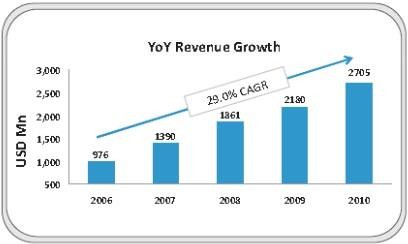
Figure no: 3
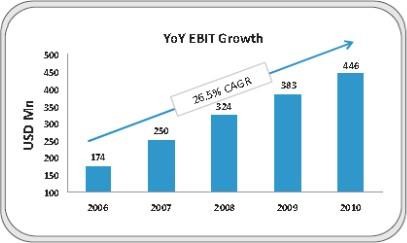
Figure no:4
Discussions
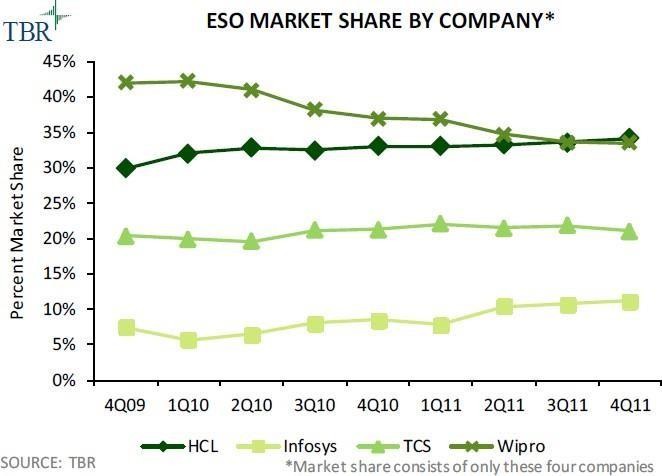
Management’s focus on employee culture as a competitive differentiator has led to a remarkable turnaround in HCL’s market share and mind share, over a period starting from 2005 to date. Since the turnaround started in 2005 by Vineet Nayar, the numbers have been impressive:
- 514% increase in annual revenue (from June 2005 to June 2013),
- 440% increase in net income (from June 2005 to June 2013),
- 244 % increase in market capitalization (from June 2005 to June 2013),
- 56% increase in revenue per employee, and 15% reduction in employee attrition rate (Sep 2005 to June 2013).
Recent trends
HCL annual results for FY 2020 have shown revenue growth of 16.7% YoY in constant currency and Net income growth of 9.3% YoY. The company has also seen a slight increase in ROE to 23.6% during this period.The total revenue of HCL Technologies Limited amounted to over 750 billion Indian rupees in the fiscal year 2021, up from about 707 billion Indian rupees in the previous fiscal year.
What has happened in the last 3 years?
- HCLT grew at a CAGR of 24 % and increased its market capitalization by 186% in the last 3 years
- Doubled the number of $10 Mn, $20 Mn & $50 Mn customers and tripled the number of
$100 Mn customers
- HCLT’s revenue per employee is amongst the highest in the Indian IT industry today
- HCLT was also featured as one of the most innovative and disruptive companies globally – - Included in the first-ever Executive Dream Team published by Fortune - Emerged as the top-ranking IT Services company in APAC, in Forbes Asia’s ‘Fab 50 List’ - Ranked by TPI in the Top 6 Global Service Providers by TCV across ALL 3 geographies (Americas, EMEA, APAC)
Conclusion
HCL Technologies is a leading worldwide technology company that aids businesses in reimagining their industries for the digital era. With a world-renowned management philosophy, a strong culture of creativity and risk-taking, and a relentless focus on customer interactions, our technology products, services, and engineering are built on four decades of innovation. With the help of our Mode 1-2-3 approach, which is based on a number of different technologies including Digital, IoT, Cloud, Automation, Cybersecurity, Analytics, Infrastructure Management, and Engineering Services, we provide an integrated portfolio of goods, services, solutions, and IP. Hence, HCL technologies are pioneering new forms of management and internal practices that truly do put the employee first. Their website is filled with interesting information about their culture of ‘ideapreneurship ‘which puts employees at the forefront of innovation, their employee-centric mission statement, and their reverse management style. Transparency & integrity are the most important values to HCL Technologies employees and because of this 50% of employees are proud to be part of HCL Technologies.
References
- Bocken, N. M., & Geradts, T. H. (2020). Barriers and drivers to sustainable business model innovation: Organization design and dynamic capabilities. Long Range Planning, 53(4), 101950.
- Bradley, A. J., & McDonald, M. P. (2011). The social organization: How to use social media to tap the collective genius of your customers and employees. Harvard Business Press.
- Chappell, P. (2013). Paper routes:" Bleak House", rubbish theory, and the character economy of realism. ELH, 80(3), 783-810.
- Daft, R. L. (2014). The leadership experience. Cengage Learning
- Gurteen, D. (1998). Knowledge, creativity and innovation. Journal of knowledge Management.
- Helps, Y., Moller, J., Kowanko, I., Harrison, J. E., O'Donnell, K., & De Crespigny, C. (2008). Aboriginal people traveling well: issues of safety, transport and health.
- London, M., & Beatty, R. W. (1993). 360-degree feedback as a competitive advantage. Human Resource Management, 32(2-3), 353-372.
- Nayar, V. (2010). Employees first, customers second: Turning conventional management upside down. Harvard Business Press.
- Tenywa, M. M., Rao, K. P. C., Tukahirwa, J. M. B., Buruchara, R. A., Adekunle, A. A., Mugabe, J., ... & Mulema, A. A. (2011). Agricultural innovation platform as a tool for development oriented research: Lessons and challenges in the formation and operationalization. Journal of Agriculture and Environmental Studies.
- Wayne Boss, R., Dunford, B. B., Boss, A. D., & McConkie, M. L. (2010). Sustainable change in the public sector: The longitudinal benefits of organization development. The Journal of Applied Behavioral Science, 46(4), 436-472.
Get an email when we publish new research and open calls for chapters.
Create a free account