
Chapter 15
Introduction
- ISBN
- 978-81-963834-0-4
- Published
- 26 July 2026
- Accesses
- 32 views · 46 downloads
- Reading time
- ~13 min
Full text
DMART: HOW IT HAS TURNED OUT TO BE INDIA’S MOST ADMIRING RETAILER?
JANANI S, HIMA BINDU N, RASHMI J
IFIM College, Bengaluru
DR. VIDHYA PILLAI
Associate Professor, IFIM College, Bengaluru
Abstract
Due to the growing demand and size of the market, the retail sector in India is among the most dynamic and expanding businesses. This case study focuses on how Dmart has turned out to be India’s most admiring retailer of the decade. DMart is a reputed company which is founded by well-known investor Radhakrishna Damani in the year 2002 operating under Avenue Supermarkets. In just a matter of a few years, it emerged as one of the most successful supermarket stores in the country with a presence in 306 locations. It is one of the lowest-priced retailers that constantly try towards understanding the customer needs so deeply and satisfy them with the proper assortment of products. Dmart is recognized as the "Indian Walmart" because of its business philosophies, vision, pricing policies, focussed approach, business model, inventive planning, and product categories. For them, the customers, merchants, and staffs are the three key pillars that support Dmart's triumph in the country. Reliable sources were used to collect the market reports to make this case study. Regardless of its incredible success in India, Dmart had to face numerous challenges ahead which consisted of intense competition, issues concerning scaling, and economic slowdown due to covid pandemic.
Keywords: Retail Supermarket, DMart retail chain
Introduction
The retail sector in India is currently undergoing significant changes, which are changing the retailing industry significantly. Today customers enjoy the benefit of being able to purchase the goods and services they need from various formats that will satisfy their needs. This case discusses how DMart has evolved as the most admired retailer in the country. Dmart is a chain of supermarkets and hypermarkets which is owned and run by Avenue Supermarts Limited, by an entrepreneur called Radhakrishna Damani in 2002. With an emphasis on providing customers with a wide assortment of products at competitive rates, DMart has swiftly become one of the top retailers in India. Since opening its first store in Powai in the year 2002. DMart has rapidly expanded throughout India, with over 306 locations in 13 states and Union Territories as of 2023. (Exhibit 1) DMart stores are often large-format establishments that sell a variety of goods, including groceries, furniture, kitchenware, appliances, and clothing.
Rise of the Indian retail segment
Retail in India is anticipated to develop faster than in any other significant market worldwide as of 2023. Retailers now routinely use omnichannel strategies. According to the ICRA research, a healthy year-over-year revenue increase of between 15% and 20% is anticipated for the F&G merchants in FY2023. However, due to inflationary pressures, the operating profit margin (OPM) is anticipated to stay range-bound at 5-6% in FY2023. According to Boston Consulting Group (BCG), Indian retail would be worth a staggering $2 trillion by 2032.Around 40 million Indians are employed in the organized and unorganized retail operations sectors. About 4% of the 14 million retail stores in the US are larger than 500 square feet (46 m2). In India, there are about 11 retail stores per 1000 people. The three main product categories with the most retail sales are groceries, apparel, and furnishings. India is ranked quite high in the world for retail; it has a sizable market, little socioeconomic risk, and little political risk.
About DMART
Avenue Supermarkets owns the D-mart supermarket chain, which is situated in India. Radhakrishnan Damani, a well-known value investor from India, founded the grocery chain in 2002. The company is named after Radhakrishna Damani, its creator. "Damani" is denoted by the "D". D-mart strives to be a one-stop retail chain with a wide selection of personal and household goods given to customers at appealingly low rates. The main goal is to provide clients with groceries and household goods at a better value. As of February 2023, the market value of DMart is $27.39 billion. Dmart is now ranked as the 636th most valuable corporation in the world. (Exhibit 2) The lower-middle, middle, and aspirant upper-middle income categories make up the majority of DMART's target market of value-conscious retail shoppers. Unlike most of its rivals, who have been losing money, DMART has been able to expand its business without experiencing margin erosion.
Success recipe of DMART
Right product mixture: Based on the size of the target customer's basket size in each of the product categories, Dmart concentrates on the most popular SKUs as per customers’ choice. They think it helps to increase sales velocity, reduce theft, and guarantee that there are fresh products on the shelves.
Sourcing competence: By making its purchases directly from producers and major suppliers, DMART avoids paying distributor/dealer margins. Due to the advance payments they make to suppliers, which it then transfers to end consumers, it is gaining cash discounts. Working with DMART results in lower revenue per km, but there is improved turnover and faster payment.
Consolidated sourcing: Around 40% centralization of DMART's total sourcing gives it more negotiating leverage. It minimizes storage expenses by keeping faster-moving goods like food and
groceries in warehouses close to its stores and slow-moving goods like clothing farther away. According to our estimates, Dmart can increase centralized sourcing to 60%, which will result in significant procurement cost savings that can be passed along to the final client.
Cluster-based methodology: DMART employs a cluster-based approach to store expansion. Within a few kilometres of its current stores and delivery sites, it opens new stores. As a result, it can better understand local requirements and preferences, expand into underserved markets, increase cost-efficiency owing to economies of scale, and boost brand recognition.
Lower employee cost: Because of its changeable workforce strategy, DMART maintains low staff costs—less than 2% of revenue. There are only 4,200 people on its direct payroll. Third-party hires make up the remainder of the workforce.
Input system of measurement: Based on the stock present in warehouses, empty shelves, the number of idle cash registers, and the degree of theft, Dmart rates its managers. Deserving employees are given access to ESOPs, fostering a sense of ownership among workers.
Business model
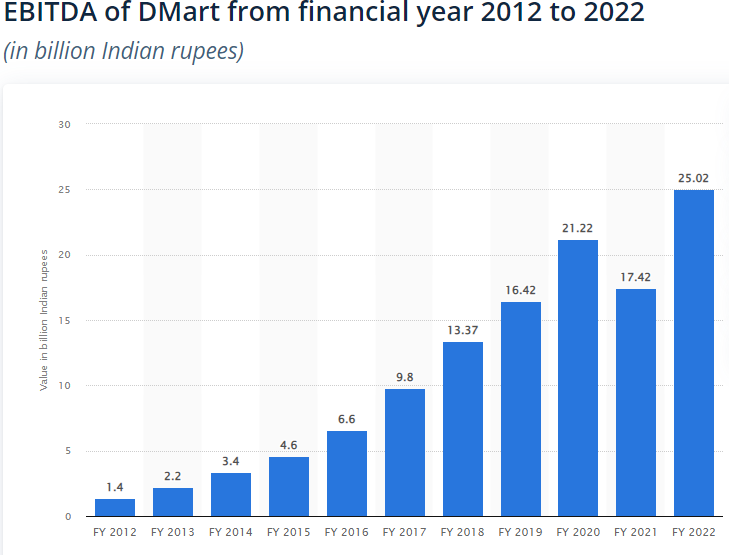
A strong business model is essential for any company to develop, thrive, and outperform its competitors. Due to DMart's business model, the company has seen exponential growth and has grown to become the most successful grocery chain in India. (Exhibit 3) Despite being the most affordable retailer, the DMart business strategy is incredibly profitable. Damani made it clear that they had to adhere to the standards established by Sam Walton because Walmart had affected him in the late 1990s.
Retail marketing mix
Product Mix: Customers can purchase a wide range of items for their households and individual usage at D-Mart in one convenient location. Since mass production is preferred, its products are available in different sizes and colors. The store includes a separate category for each product, making it simple for customers to select the item they want to buy. Based on the products, the space is divided. Their products include utility products such as toys and games, office supplies, cosmetics, food, toiletries, bed and bath linens, clothing, kitchenware, household appliances, shoes, and more are available.
Price Mix: All the products sold by the retail company D-Mart are priced reasonably. To appeal to the market's price sensitivity, the company has adopted a low-cost strategy. It must maintain costs at reasonable and competitive levels because mass manufacturing is its guiding philosophy, making it simple for a customer to purchase. Simple pricing that is nonetheless accessible to clients is a key component of D-business Mart's strategy. It always gives a minimum reduction of 5% off the MRP on all items, except for fruits, groceries, produce, and prescription medications. D-Mart has also adopted a discount pricing strategy, offering its customers appealing bargains and other incentives on occasion, especially during festival seasons.
Place Mix: D-Mart provides access to most of India's major cities, including Mumbai, Kolhapur in Maharashtra, Surat, Rajkot, and Bhuj in Ahmedabad, Tirupati in Andhra Pradesh, Hyderabad in Telangana, Bengaluru in Karnataka, Surat, and Hyderabad in Gujarat. Better management has resulted from DMART's deliberate decision to open stores in ce rtain localities within a given state. The majority of DMart locations are found in metro areas.
Dmart's well-built supply chain management includes planning, merchandising, sourcing, vendor management, logistics, quality control, pilferage control, replacement, and replenishment. Profitability in the retail sector depends on excellent inventory management. Dmart's cluster-based retail development model enables them to achieve best-in-class inventory turnover. It has implemented SAP to ensure real-time inventory and supply chain management.
Promotion Mix: To maintain its status as one of the best, D-Mart, one of the largest multi-brand enterprises in India, has used a variety of promotional strategies. Gift coupons are offered for employee retention, and vouchers are also given to visitors who meet specific volume purchase requirements during times when sales are slow. Holiday seasons are filled with discounts; for instance, Cadbury products were 10% off during Raksha Bandhan. Hoardings help D-Mart increase publicity and brand recognition. With its promotional initiatives, which are reported in publications, the latest offers and objectives are generally recognized.
Physical evidence: The Operating costs are kept under control by the huge size (the average shop is 28,000 square feet) and unpretentious retail design and decor. For its pilot pick-up store, D-Mart Ready, the retailer is experimenting with the leased store model. It employs no-frills store designs, opens locations outside of malls in high-traffic residential areas, offers fewer no-frills product options, and controls most of its stores, which lowers operational costs and produces best-in-class revenue per square foot.
People Mix: To meet its workforce needs, Dmart employs both important personnel permanently and contracts with individuals for positions with significant attrition rates. It currently has 4,200 people working for it. It also helps to keep costs down as a substantial portion of its floor employees and security personnel are employed under contracts. Employee costs at Dmart have continuously been less than 2% of revenue.
Customer Service: Dmart places a high priority on superior customer service. Their workers adhere to the Action, Care, and Truth (ACT) ideals to complete tasks with dedication and tenacity. A well-trained team that is well-equipped to manage consumers is present in every D-Mart location. Every employee works very well together, and each section has a boss with the necessary level of expertise.
Challenges
DMart has experienced several significant obstacles, such as:
Fierce competition: Numerous competitors are seeking a share in India's retail industry, which is very competitive. Both domestic and foreign competitors might have an impact on DMart's growth and profitability.
Disruptions in the supply chain: DMart sources its products from producers and farmers through
a complicated supply chain. Any supply chain snags, including transport disruptions or weather-related problems, can affect the products' availability and result in lost sales.
Fluctuating raw material prices: DMart offers a wide variety of food and non-food products, many of which are impacted by changes in the price of raw materials. The profitability and profits of the business may be impacted.
Fast growth: Since launching new stores and increasing its operations, DMart has been growing quickly. This might be difficult because it calls for a sizable investment of resources and money along with the requirement to locate adequate spaces and recruit and train additional workers.
Economic downturns: DMart is affected by economic recessions and fluctuations, just like any other firm. Consumer spending may decline because of an economic downturn, which could affect the business's sales and profitability.
Change in Customer choice: Customer preferences are continuously changing, and for DMart to stay relevant, it is important to stay on top of these trends. If you don't, you can lose out on sales and have fewer loyal customers.
Competition from e-tailers: In India, e-commerce has experienced fierce competition because of numerous e-tailers' ongoing deals and steep discounts. DMART’s rivals may have more financial means and online company management expertise than it does. Its online and offline businesses may suffer if it is unable to successfully compete with e-tailers.
Lack of sensing trends and consumer preferences: The right product assortment based on local product preferences and the awareness of changing customer trends is the key to DMART's higher income per square foot. The business may not run smoothly if DMART is unable to replicate this in the new states it enters. This could jeopardize its long-term expansion strategy.
DMart has managed to maintain its position in the market and grow its business despite these obstacles. The business has a solid management group and a tried-and-true business plan that have enabled it to successfully traverse the difficulties of the retail sector. Trends
Road ahead
As DMart has a solid brand and a tried-and-true business model, the company's future seems bright. It's anticipated that DMart would proceed with its expansion ambitions, with an emphasis on adding new locations and growing its business throughout India. In the upcoming years, the company wants to open 300 outlets, which will necessitate a large commitment of funds and resources. Additionally, it is anticipated that DMart would maintain its commitment to giving customers a first-rate shopping experience and a broad selection of goods at affordable costs. To further broaden its market and adapt to shifting consumer preferences, the corporation may also investigate new business prospects, such as digital shopping and home delivery. Also, DMart might keep making technology investments to advance its processes and boost productivity. To boost productivity and profitability, this could involve making investments in supply chain management, data analytics, and automation. Intense competition, interruptions in the supply chain, and shifting consumer preferences are just a few of the difficulties that DMart will have to deal with as it navigates the retail sector. Brick-and-mortar businesses have a fantastic opportunity to execute genuine omnichannel marketing and engage their already growing client base.
D'Mart, the most valuable retailer in the nation, has recognized the importance of this and started
on a truly omnichannel journey. Little D'Mart Ready stores have been established throughout Mumbai, where clients may pick up the items they have ordered online. To remain effective in a competitive market, the organization will need to keep innovating and adapting. Therefore, DMart has a promising future because it is well-positioned to maintain its expansion and success in India's retail market.
EXHIBITS:
Exhibit 1: Dmart’s Market cap
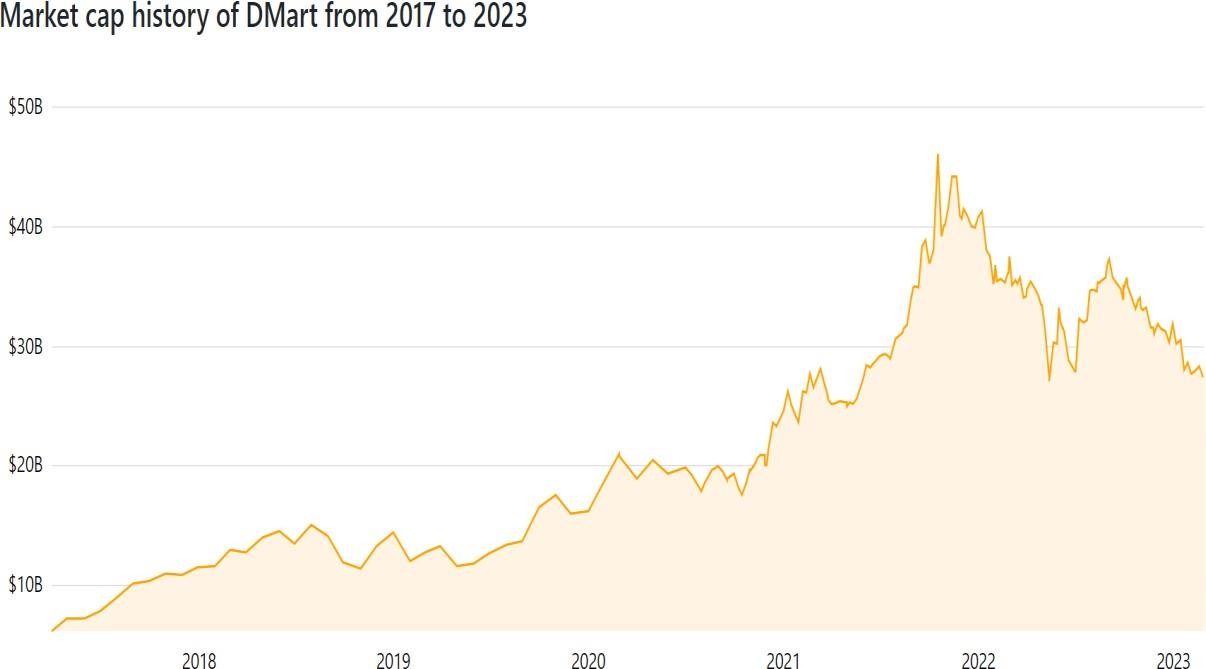
Exhibit 2: Milestones of Dmart
|
2002 |
Started the store in Mumbai |
|---|---|
|
2007 |
DMart began its expansion |
|
2012-2013 |
In India, DMart is now the third-largest branded retail chain after seeing a sharp increase in revenue to Rs. 3,334 crores. |
|
2014 |
Reached to account for 73 stores across Maharashtra, Gujarat, Hyderabad, and Bangalore. |
|
2015 |
DMart reported revenues of Rs. 6450 crores and a profit of Rs. 211 crores in FY14–15. |
|
2017 |
The company went public |
|
2020 |
The two retail locations that DMart had in Mumbai were shut down and turned into fulfilment facilities. |
|
2021 |
For the three months that ended on June 30, 2021, total revenue was Rs. 5,183 crores (US$ 701.07 million). |
|
2023 |
Total revenue in the second quarter of FY 2022-23 stood at Rs. 10,428.42 crores (US$ 1.28 billion). |
References
- “How DMart became a retail giant”, Live Mint, September 5, 2021
- “DMart’s success: How Radhakishan Damani built a retail empire”, Business Today, June 6, 2018
- "Avenue Supermarts IPO: 10 things to know about D-Mart's parent company", Financial Express, March 8, 2017.
- "DMart's rise reflects India's shopper evolution", Financial Times, April 15, 2018.
- "DMart, a retail success story", The Hindu, February 15, 2022.
- M. Guruprasad (2018). “Study on the Consumer Preference and Perception of Supermarket Chain - Case of D-Mart”, International Journal of Innovative Science and Research Technology.
- V, R. P., & Nair, R. (2010). A comparative study of service quality of D’Mart and Apna bazaar. IUP Journal of Management Research, 9(4), 7-20.
- Negi, Sumit & Bhide, Manish & Batra, Vishal & Mohania, Mukesh & Bajpai, Sunil. (2012). D’MART: A Tool for Building and Populating Data Warehouse Model from Existing Reports and Tables. 102-113.
- Rajesh Mascarenhas, Radhakishan Damani becomes India's 2nd richest person, The Economic Times, economictimes.indiatimes.com/markets/stocks/news/DMarts-radhakishan-damani-now-indiassecond-richest-individual/articleshow/74151939.cms
Get an email when we publish new research and open calls for chapters.
Create a free account