
Chapter 12
ORGANIZATIONAL DISABILITY: A NEW CONCEPT TO IMPROVE EMPLOYEE PRODUCTIVITY
- ISBN
- 978-81-963834-0-4
- Published
- 26 July 2026
- Accesses
- 26 views · 47 downloads
- Reading time
- ~25 min
Full text
ORGANIZATIONAL DISABILITY: A NEW CONCEPT TO IMPROVE EMPLOYEE PRODUCTIVITY
DR. SUMIT SAHA
Associate Professor, Dayananda Sagar Business School, Bangalore
Abstract
This research work is not concerned with the physical disabilities of employees but purely focuses on the barriers and unfavourable conditions at the workplace for which employees cannot give their best during their employment. It is a way to look at existing organizational barriers or disabilities differently which prevents employees to get the best effort out of them. Employees in a healthy organization with good working conditions, a supportive work climate, healthy employees, and accessibility of buildings and facilities will have higher morale, which has a positive influence on the quality and productivity of work. This research reveals the areas where employees are needed to be enabled. A comparative analysis of different types of Industries (IT and Non-IT both) disabilities. How “Employee Enabling System” can be formed and implemented in an organization. Also, definitely, there is a need for a model which can easily identify the required factors and a scale to measure/ quantify statistically these factors which affect negatively on employee performance. How it leads to positive financial results with a reduction in costs and rising profitability. This research is completely exploratory research in nature. This research reveals the areas where organizations need improvement.
Keywords: Organizational Disability Index, flexible work culture, appraisal system, Human Capital Management, Organizational Change, Organizational Disability, Organizational Development
Introduction
In today’s world, everything is attached to financial factors. This research work does not say anything about the physical disabilities of any employees but purely focuses on the barriers, and unfavourable conditions at the workplace for which employees cannot give their best during their employment. It is also a step to measure the existing disabilities in any organization. In today's competitive business landscape, organizations are continuously seeking innovative strategies to enhance employee productivity and maintain a sustainable advantage. While efforts have traditionally focused on improving processes, technology, and leadership, there is a new concept gaining attention: Organizational Disability. This essay explores the concept of Organizational Disability and how it can contribute to improving employee productivity. By understanding and addressing the various factors that hinder productivity within an organization, businesses can create an inclusive and empowering work environment that maximizes the potential of their workforce.
Defining Organizational Disability: Organizational Disability can be understood as the internal barriers, limitations, and inefficiencies that hinder employees' performance and prevent them from
reaching their full potential. Similar to how individuals with disabilities may face obstacles in society, organizations can also suffer from "disabilities" that limit their ability to function optimally. These disabilities can manifest in various ways, such as ineffective communication channels, bureaucratic structures, inadequate training programs, rigid hierarchies, lack of recognition, and resistance to change.
Identifying Organizational Disabilities: To improve employee productivity, organizations must first identify and recognize the disabilities present within their structure. This requires a thorough analysis of the organization's processes, systems, and culture. Managers should engage in open and honest dialogue with employees, seeking their input and feedback regarding potential barriers to productivity. Additionally, conducting surveys, focus groups, and performance evaluations can provide valuable insights into the challenges faced by employees and areas that require improvement.
Addressing Organizational Disabilities: Once the disabilities are identified, organizations must take proactive measures to address them. Here are some strategies that can be employed:
Foster a culture of inclusion: Promote an inclusive work environment where employees feel valued and empowered to contribute their ideas. Encourage collaboration, diversity, and open communication, breaking down barriers between different departments and levels of hierarchy.
Streamline communication channels: Improve communication systems by implementing efficient tools and processes. Embrace technology platforms that facilitate real-time collaboration, information sharing, and feedback. Encourage transparent communication across all levels of the organization.
Provide continuous learning opportunities: Invest in employee training and development programs that focus on enhancing skills, knowledge, and adaptability. Offer opportunities for employees to acquire new competencies and stay up-to-date with industry trends. This will enable them to perform their roles more effectively and contribute to the organization's growth.
Flatten hierarchies and empower decision-making: Move away from rigid hierarchies and empower employees at all levels to make decisions within their respective domains. Encourage autonomy and ownership, enabling employees to take responsibility for their work and drive innovation.
Recognize and reward performance: Establish a system of recognition and rewards that celebrates and acknowledges employee achievements. This can be in the form of monetary incentives, public recognition, career growth opportunities, or a combination of these. Recognizing and rewarding employees fosters motivation, engagement, and increased productivity.
Organizational Disability represents a new concept that emphasizes the need for organizations to identify and address internal barriers that hinder employee productivity. By recognizing and overcoming these disabilities, organizations can create a work environment that promotes inclusivity, collaboration, and continuous learning. Empowered employees are more likely to be motivated, engaged, and productive, leading to enhanced organizational performance and competitive advantage. It is essential for businesses to embrace the concept of Organizational Disability and make it an integral part of their strategy for sustainable growth in the dynamic and evolving business landscape.
Literature Review
Employees in a healthy organisation with good working conditions, changing working hours a supportive work climate, healthy employees, and accessibility of buildings and facilities [2] will have higher morale, which has a positive influence on the quality and productivity of work. Dr. Meredith Belbin’s team role analysis [4] technique gives a fair idea to assign the team role among the team members to have an effective outcome for the team. Human Rights and Equal Opportunity Act [5] reveals employee rights, Drucker, Peter F. (1988) expresses a strong idea about “The Coming of the New Organization”.
Prior research has focussed predominantly on identifying obstacles to career success within organisations. For instance, research has demonstrated how biases against those with a disability, or human resource practises such as crafting of 'ideal' job profiles, or unreliable appraisal instruments may cause those with a disability to miss out on certain positions, training or mentoring opportunities, and may negatively impact performance ratings, job assignments, or pay increases (Feldman, 2004; Schur, Kruse, & Blanck, 2005; Stone & Colella, 1996). Barriers to career success may also begin with employer biases that make it difficult for individuals with disabilities to obtain employment (Lengnick-Hall, Gaunt, & Kulkarni, Citation2008), which contributes to their low employment rates (Braddock & Bachelder, Citation1994; Schur, Kruse, & Blanck, 2013; World Health Organisation, 2011).
Relatedly, past research has identified which employees with a disability are more likely to face discrimination (e.g., those with lower levels of education or lower self-efficacy; Balser, Citation2000; Feldman, Citation2004; Lindstrom, Doren, & Miesch, Citation2011) or be more successful (e.g., those who can form and utilise social networks; Kulkarni & Gopakumar, Citation2014; Noonan et al. This paper adds to this corpus of research by highlighting how employers are assisting employees with disabilities through career development initiatives within organisations. Thus, the focus of this paper is not on career-related barriers, but rather on organisational enablers for employees with disabilities.
In addition, the paper contributes to the literature on developing careers among a diverse workforce, a topic of practical significance to employers and human resource professionals. Disability is a form of diversity (Dipboye & Colella, 2005; Lengnick-Hall et al., 2008), and as incidence of disability is on the rise internationally (World Health Organisation, 2011), how to best develop and employ talent from one of the largest underutilised labour pools is an important topic for employers and human resource professionals (Baumgartner, Dwertmann, Bohm, & Bruch, 2014; Schur et al., 2014). Human resource practises are crucial in determining access to organisational opportunities and rewards, and thus influence promotion and advancement opportunities, particularly for minorities such as those with a disability (Klimoski & Donahoo, Citation1997). Insofar as certain practises are generalizable, it may be useful to describe what employers have done to assist the career development of individuals with disabilities.
Normally, in today’s era, websites give us valuable information. Regarding this research websites mentioned in Bibliography helped me a lot along with the above-mentioned literature and published research papers.
Hypothesis:
Enabling employees to overcome organizational disabilities at the workplace leads to positive financial results with a reduction in costs and rising profitability.
Research Problem:
This research work is not concerned about the physical disabilities of employees, but the unfavourable conditions at the workplace for which employees can’t give their best during their employment. To identify the organizational barriers at the workplace and how enabling middle-level managers leads to positive financial results with reduced costs and rising profitability.
Research Objectives:
- To identify disability-creating conditions at the workplace and find out the ways to enable middle-level managers to overcome those disabilities.
- A comparative analysis of different types of Industries (IT and Non-IT) disabilities.
- A “statistical model” to identify and measure the existing Disabilities.
Scope of the Research Work:
It will help to know about various factors which make employees disabled so that middle-level managers (old organizations- sr. executive, assistant managers, Deputy managers, Sr. Managers, deputy general managers and in new organizations- sr. executive, assistant managers, managers, Sr. Managers) or employees of similar positions with 2-10 years of experience mainly in Telecom/IT/Banking or Financial/Manufacturing Industries of the west-India (Mumbai only) can be enabled.
Research Methodology
The instrument used for the research purpose was a structured questionnaire. The questionnaire was designed keeping in mind the objectives of the study. This questionnaire consisted of 80 statements.
Pre-Test / Pilot Survey
Before the final questionnaire was administered to the sample, it was administered to 10 people to gather opinions about the instrument, thereby reducing the complexity of the same. They were requested to point out irrelevant and vague statements and offer suggestions to improve the instrument. After pre-testing, those questions considered relevant by the respondents were retained and those considered irrelevant by the respondents were ignored and didn’t appear in the final questionnaire. Questions that were “not clear” were rephrased.
Here are ten (10) different factors for which employees are disabled by the organization. This is to be noted that these 10 major factors were identified through the pilot survey and focused group discussion for the final study:
Job description indicated in the job advertisement, Appraisal system, Infrastructural Disabilities, Caring for employees' personal problems ,Flexibility to work, Team working, Conflict Management,Relations with Superiors,Work Climate, Exit from the company
Sampling Plan
- Sampling Unit: Middle-level managers & similar positions employees in Mumbai region only.
- Sample Size: 195
- Sampling Procedure: With more than 2 years of experience in the IT Industry and different Industries like Telecom, Banking & Financial, Manufacturing and others (e.g., Retail, Service etc.). I tried to find out the comparative analysis in different industries and where they are at present in creating disabilities for their employees at the workplace.
- Sampling model: cluster sampling
- Sampling method: Random method. Irrelevant or incomplete samples were not taken into consideration for the final data analysis.
Data sources
Professionals and managers of different companies in Mumbai only. The participants were chosen in such a way that they represent the occupation-based categorization.
Data collection:
The fieldwork was carried out for a period of 40 days. Respondents of different occupational levels were approached in person by me the researcher. The samples were chosen in such a way that they also reasonably represented the different age groups, experience groups and Industries. A reasonable distribution of the samples across the different areas and different companies of the city was also taken care of, in order to minimize bias and to get the heterogeneous data. Information was analyzed based on Qualitative and Quantitative techniques using statistical tools, Microsoft Excel. Based on focus group discussion out of 25 different factors researcher chose ten (10) different independent variables for this study. The respondents were from different companies mainly Bayer Business Services, Informedia India, Reliance Communication Ltd., Vashi, HP-Mumbai, Mastek-Mumbai, Polaris Software Lab Ltd, Siemens Ltd, Honeywell Automation India Ltd, Accenture, 3i Infotech, Vodafone, ZTE, Mumbai, Corporation bank, SBI, Mumbai, Godrej & Boyce Mfg Co. Ltd, L&T Mumbai, Lehman Brothers, Sandoz Pvt ltd etc., and experience wise the sample was considered those who have more than 2 years of experience. 3 samples with less than 2 years of experience were removed.
In the total questionnaire, there were 68 different statements to identify the existing situations in 10 different organizational areas. i.e., an average of 6-7 statements per area. The followings are the analysis of data obtained by the survey.
Data Analysis:
76% of the respondents met the expectations visualized at the time of the interview. In fact, this question was asked to identify the GAP between the expectations at the time of the interview and the achieved expectations after joining the company, and the purpose was well served. However, half of the respondents believe that they are underutilized.
Respondents are sticking to the same company, being reasons like signed a bond, a Good working environment, job satisfaction and different opportunities, job satisfaction, brand name, learning, growth, job security, culture, work flexibility, pay package, loan and to do freelance work.
62% of respondents know that during appraisal reviewers are given preferential treatment during the appraisal, and it definitely makes them unhappy about the company appraisal system. 360-degree
appraisal encourages more open feedback. This type of appraisal also gives people a more rounded view of performance. Employees suggest implementing a 360-degree appraisal system in their company.
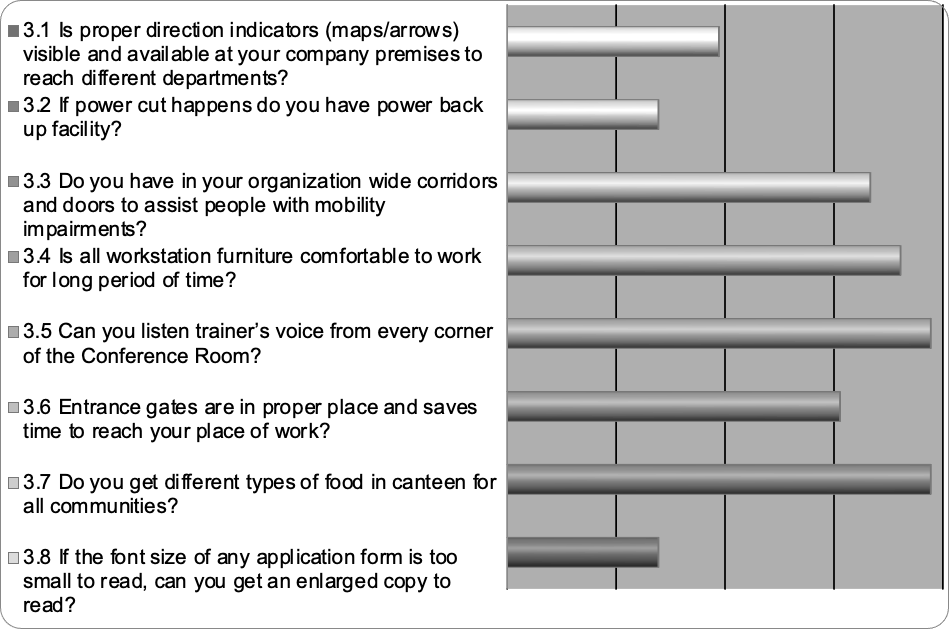
Infrastructure Shortfalls in IT Industries reflect Canteen facilities, Transportation & Security, Maintenance, Crowded cubicles, Recreation etc.
Fig 1: Infrastructure shortfall
Respondents strongly agree that caring for employees' personal problems gives a chance to employees for better performance. According to the study approximately 3 days per week an employee takes work at home. Different communities have different main festivals. For Hindu Iid/ Muharram, it’s a holiday only, but he can take this leave during their main festival Ganesh Chaturthi instead of taking it at the time of Muharram, and vice versa. In this way, the company will remain open at all festivals, including flexible per-day work timing. There is no substitute for playing in a team. Quality employees want to work with quality co-employees focused on a winning effort. All espondents agreed that team role is not assigned at all according to Dr. Meredith Belbin’s Team Role Analysis. Most of them revealed that in a team role is assigned to Experience, skills, attitude and learning ability. Surprisingly no one is aware of this technique. 61% said they work with great people but 39% said they not.
Table-1: Team working
|
Strongly Disagree |
11.11111 |
5.555556 |
0 |
|---|---|---|---|
|
Disagree |
|||
|
16.66667 |
11.11111 |
11.11111 |
|
|
Undecided |
|||
|
16.66667 |
27.77778 |
16.66667 |
|
|
Agree |
|||
|
44.44444 |
44.44444 |
55.55556 |
|
|
Strongly Agree |
|||
|
11.11111 |
11.11111 |
16.66667 |
- better software, resources, additional training
- better support from other departments like marketing and sponsorship
- data entry operator, better team & work culture
- infrastructure and communication tools
- less workload, new ideas are not entertained
- manpower support and adequate time
- more authority, challenges with more freedom
- more opportunities to interact with cross-functional activities
- motivation and guidance from seniors
- support and appreciation for good works
- Better training and development
- want to handle a team and more responsibilities
22% of employees witnessed the unethical practices engaged in by employees/ management, but 90% of them never disclosed that to the appropriate authority.
An exit interview is important for any organization to understand the truth about the organization, mainly the management, culture and process.
When the researcher wanted to know why respondents stay with the organization, the following answers were revealed:
- Better prospect & challenging job.
- Flexibilities in timings
- Newly joined
- Opportunity to grow, to gain experience
- To learn the business domain
- Work experience, Work-life balance
More pressure from the boss, not transparent appraisal process, better package and job profile, management and resource problems, some profiles with no change in work, monotonous job, unjustified Deadlines, work culture and pay scale etc make one think about leaving the organization.
When one leaves the company the exit interview is important, however, this is also true that employees do not disclose the true reason to the HR at the time of leaving. The best way to know the truth is to ask their colleagues. When the researcher wanted to investigate the true reason for leaving then the following shocking reasons were revealed:
- management refused to increase pay
- better exposure, salary & a better brand company
- better job responsibilities and monetary benefits
- better lifestyle
- better opportunity as well as employee was under-utilization
- due to more work pressure. Continuous daily 12 hrs work
- got a better post with a very high salary(almost three times more)
- harassment by superiors and good opportunities outside
- effort was not recognized.
- immediate boss’s attitude
- internal conflict and injustice
- job satisfaction not there
- different role with a better profile and monetary benefit.
- monetary reasons and lack of respect
- monotonous job
- no promotion even though he deserved it.
- An unhealthy relationship with the boss
Table-2: Exiting from the company
|
* All in % |
10.4 Did (s)he discuss with you specific reasons why they were leaving? |
10.5 Did (s)he disclose the cause at the exit interview? |
10.6 Do you assist employees who are moving on to new jobs? |
|---|---|---|---|
|
Yes No |
61.1111 |
33.33333 |
55.55556 |
|
38.88889 |
61.11111 |
44.44444 |
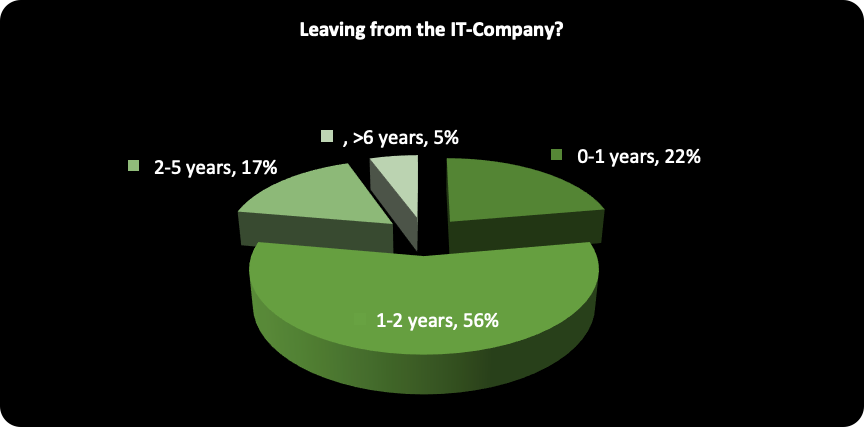
For any organization, research revealed that employees' attitude towards its company is divided into clear two dimensions as follows.
Negatives:
- Top management is too much into politics & not able to manage properly
- No growth, no variety of work & lots of politics
- No proper direction and guidance from superiors in order to grow.
- Authoritarian leadership style
Positives:
- Very good for freshers for getting experience and training
- Adjusting problem but growth opportunity
- For learning & better package.
- Job security
- But not the department in which I work
- For getting experience in only a short period of time
Table-3: Comparative Rank of different disability creating conditions
|
Factors |
Factors Description |
Rank-IT |
Rank- Banking/Fin ancial |
Rank- Manufacturin g |
Rank- (Other s) |
Rank - Over all |
|---|---|---|---|---|---|---|
|
1 |
Job description indicated in the job Advertisement/ at the time of interview |
3 |
3 |
2 |
2 |
2 |
|
2 |
Appraisal system |
1 |
6 |
1 |
5 |
1 |
|
3 |
Infrastructural Disabilities |
5 |
7 |
3 |
6 |
7 |
|
4 |
Caring for employees’ personal problems |
8 |
10 |
4 |
8 |
8 |
|
5 |
Flexibility to work |
9 |
8 |
6 |
1 |
6 |
|
6 |
Team working |
2 |
9 |
7 |
9 |
5 |
|
7 |
Conflict Management |
10 |
4 |
8 |
4 |
9 |
|
8 |
Relations with Superiors |
6 |
1 |
5 |
7 |
4 |
|
9 |
Work climate |
4 |
2 |
9 |
10 |
3 |
|
10 |
Exit from the company |
7 |
5 |
10 |
3 |
10 |
After applying different Statistical tools to available data we got different interesting results. The following are the correlations between different factors existing in the IT industries
and other industries' situations. Here, correlations identify the conditions by which employees can have a bad or good impact.
Table- 4: Correlation in between Different Disabilities (IT Industries)
|
Declaring Poor/imp roper job descriptio n |
Ap prai sal syst em |
Infras tructu ral Disabi lities |
Emplo yees’ person al proble ms |
Flexi ble worki ng Clima te |
Defi ning tea m role |
Conf lict Man age ment |
Relat ions with Supe rior |
W or k cli ma te |
Exit fro m com pan y |
|
|---|---|---|---|---|---|---|---|---|---|---|
|
Declaring Poor/imp roper job descriptio n |
1 |
|||||||||
|
Appraisal system |
-0.09518 |
1 |
||||||||
|
Infrastru ctural Disabiliti es |
-0.35955 |
- 0.39 59 |
1 |
|||||||
|
Employee s’ personal problems |
-0.20733 |
- 0.21 954 |
0.601 |
1 |
||||||
|
Flexible working Climate |
-0.42011 |
- 0.00 57 |
0.2186 75 |
0.0826 89 |
1 |
|||||
|
Defining team role |
0.154082 |
0.09 323 9 |
- 0.2502 |
- 0.3175 3 |
0.128 758 |
1 |
||||
|
Conflict Manage ment |
-0.44866 |
- 0.11 338 |
- 0.0778 6 |
-0.5286 |
0.131 736 |
- 0.01 619 |
1 |
|||
|
Relations with Superior |
-0.52568 |
- 0.36 427 |
- 0.0743 3 |
- 0.1173 7 |
0.138 69 |
- 0.31 256 |
0.610
181 |
1 |
||
|
Work climate |
-0.31114 |
- 0.48 259 |
0.0115 99 |
- 0.1480 7 |
- 0.077 44 |
- 0.51 407 |
0.55 |
0.731
503 |
1 |
|
|
Exit from Company |
0.38851 |
- 0.18 701 |
0.0462 67 |
0.0793 09 |
- 0.574 13 |
0.46 719 4 |
- 0.445 92 |
- 0.390 3 |
- 0.3 86 27 |
1 |
|
Declaring Poor/imp roper job descriptio n |
Ap prai sal syst em |
Infras tructu ral Disabi lities |
Emplo yees person al proble ms |
Flexi ble worki ng Clima te |
Defi ning tea m role |
Conf lict Man age ment |
Relat ions with Supe rior |
W or k cli ma te |
Exit fro m com pan y |
|
|---|---|---|---|---|---|---|---|---|---|---|
|
Declaring Poor/imp roper job descriptio n |
1 |
|||||||||
|
Appraisal system |
-0.13114 |
1 |
||||||||
|
Infrastru ctural Disabiliti es |
-0.79634 |
0.11 460 1 |
1 |
|||||||
|
Employee s personal problems |
0.317421 |
0.13 470 7 |
0.0010 22 |
1 |
||||||
|
Flexible working Climate |
-0.26803 |
- 0.17 273 |
0.3922 52 |
0.0744 75 |
1 |
|||||
|
Defining team role |
0.567151 |
- 0.29 968 |
- 0.4710 4 |
0.6139
91 |
- 0.336 6 |
1 |
||||
|
Conflict Manage ment |
-0.57116 |
0.33 067 3 |
0.4087 57 |
- 0.3771 1 |
0.177 985 |
- 0.37 987 |
1 |
|||
|
Relations with Superior |
-0.36178 |
0.09 259 2 |
0.2489 11 |
- 0.5675 6 |
0.407 009 |
- 0.57 329 |
0.482 465 |
1 |
||
|
Work climate |
0.030805 |
0.33 761 |
- 0.0440 2 |
-0.0228 |
- 0.194 77 |
- 0.15 224 |
- 0.011 86 |
- 0.101 39 |
1 |
|
|
Exit from Company |
-0.14417 |
- 0.31 986 |
- 0.1190 9 |
- 0.3591 8 |
- 0.457 62 |
- 0.04 759 |
- 0.273 35 |
- 0.311 3 |
- 0.2 82 39 |
1 |
|
Declaring Poor/imp roper job descriptio n |
Ap prai sal syst em |
Infras tructu ral Disabi lities |
Emplo yees person al proble ms |
Flexi ble worki ng Clima te |
Defi ning tea m role |
Conf lict Man age ment |
Relat ions with Supe rior |
W or k cli ma te |
Exit fro m com pan y |
|
|---|---|---|---|---|---|---|---|---|---|---|
|
Declaring Poor/imp roper job descriptio n |
1 |
|||||||||
|
Appraisal system |
-0.09518 |
1 |
||||||||
|
Infrastru ctural Disabiliti es |
-0.35955 |
- 0.39 59 |
1 |
|||||||
|
Employee s personal problems |
-0.20733 |
- 0.21 954 |
0.5977
81 |
1 |
||||||
|
Flexible working Climate |
-0.42011 |
- 0.00 57 |
0.2186 75 |
0.0826 89 |
1 |
|||||
|
Defining team role |
0.154082 |
0.09 323 9 |
- 0.2502 |
- 0.3175 3 |
0.128 758 |
1 |
||||
|
Conflict Manage ment |
-0.44866 |
- 0.11 338 |
- 0.0778 6 |
-0.5286 |
0.131 736 |
- 0.01 619 |
1 |
|||
|
Relations with Superior |
-0.52568 |
- 0.36 427 |
- 0.0743 3 |
- 0.1173 7 |
0.138 69 |
- 0.31 256 |
0.610
181 |
1 |
||
|
Work climate |
-0.31114 |
- 0.48 259 |
0.0115 99 |
- 0.1480 7 |
- 0.077 44 |
- 0.51 407 |
0.598
946 |
0.731
503 |
1 |
|
|
Exit from Company |
0.38851 |
- 0.18 701 |
0.0462 67 |
0.0793 09 |
- 0.574 13 |
0.46
719 4 |
- 0.445 92 |
- 0.390 3 |
- 0.3 86 27 |
1 |
|
Declaring Poor/imp roper job descriptio n |
Ap prai sal syst em |
Infras tructu ral Disabi lities |
Emplo yees person al proble ms |
Flexi ble worki ng Clima te |
Defi ning tea m role |
Conf lict Man age ment |
Relat ions with Supe rior |
W or k cli ma te |
Exit fro m com pan y |
|
|---|---|---|---|---|---|---|---|---|---|---|
|
Declaring Poor/imp roper job descriptio n |
1 |
|||||||||
|
Appraisal system |
-0.13632 |
1 |
||||||||
|
Infrastru ctural Disabiliti es |
0.247487 |
- 0.20 911 |
1 |
|||||||
|
Employee s personal problems |
-0.36761 |
- 0.43 444 |
- 0.3092 3 |
1 |
||||||
|
Flexible working Climate |
-0.1612 |
- 0.21 268 |
- 0.3368 1 |
0.6360
88 |
1 |
|||||
|
Defining team role |
-0.36329 |
0.27 482 8 |
- 0.3525 6 |
0.0302 31 |
0.037 446 |
1 |
||||
|
Conflict Manage ment |
-0.19059 |
0.15 312 8 |
- 0.2154 7 |
0.1166 83 |
- 0.156 94 |
- 0.25 052 |
1 |
|||
|
Relations with Superior |
0.083639 |
- 0.20 161 |
0.3379 46 |
-0.2701 |
- 0.456 57 |
- 0.42 323 |
0.050 912 |
1 |
||
|
Work climate |
-0.39061 |
0.08 482 5 |
- 0.2072 6 |
-0.1196 |
- 0.378 6 |
0.59
530 |
- 0.207 56 |
- 0.101 07 |
1 |
|
|
Exit from Company |
-0.14935 |
- 0.33 939 |
0.1925 54 |
- 0.2243 6 |
- 0.183 39 |
- 0.23 355 |
- 0.236 61 |
0.056 162 |
0.2 19 87 2 |
1 |
i.e., according to the study, this value is
Interpretation of the Proposed Model:
It means, after conducting the survey in any organization, and data analysis we get a value lesser than the above value (2405.831592) it means that Organization has negligible disabilities, but if the value is higher than the above value, that means that the organization has the existing Disabilities and more the difference is more dominant disabilities which hamper the productivity and efficiency of that organizations. Possibly no organization can have NULL Disability, so this is the responsibility of the management always to keep an eye and fair idea about disability-creating conditions, so that, employees are not forced to become disabled. As a result, an organization will be enabled to overcome organizational disabilities at the workplace which leads to positive financial results with a reduction in costs and rising profitability.
Achievement of Research Objectives:
- Found out the 10 different areas where employees needed to be enabled especially in IT industries.
- A comparative analysis has been done of different types of Industries’ (IT and Non-IT) disabilities to understand the present scenario of the IT industry compared to other industries in terms of existing Disabilities.
- Proposed a “Disability Comparative Index Model” by which we can measure Disabilities. Hence, the objectives of this research have been achieved.
Recommendations:
Create an “Employee Enabling System” to identify the disabilities creating conditions which will lead to positive financial results with a reduction in costs, and attrition rate and will increase profit. Different communities have different main festivals. For Hindu Iid /Muharram it’s a holiday only, but he can take this leave during their main festival Ganesh Chaturthi/ Durga Puja instead of taking it at the time of Muharram, and vice versa. In this way the company will remain open at all festivals and employees will be happy too. Productivity will be increased also. However, this rule may not
be applicable for the same and other B2B customer-facing roles as B2B companies may also have a vacation on the same days.In most cases, employees are given preferential treatment or discriminated against by the immediate superior during the performance appraisal procedure. Corporate politics and partiality are some of them. As a result, employees feel insecure, not recognized for their honest attempt to give their best and start thinking about leaving the organization. So it is the best policy “Not to deprive” employees of their appropriate appraisal. If any dispute arises and 360-degree appraisal is not possible, do not depend upon only the immediate superior at the time of giving appraisal, take employees’ feedback after appraisal by a third party. Try to take an exam or interview by any knowledgeable person (without informing the appraiser and appraisee) of that employee based on his job which he has performed during the last appraisal period. and keep politics away from this.Right to speech, encouraging open constructive thought, the attitude of Immediate Superior, regular team meetings, Route Analysis, and creating awareness are some of the ways to handle Conflict Mechanisms and can be possible to maintain a good relationship with superiors.There is no substitute for playing a team. Quality employees want to work with quality co-employees focused on a winning effort. Do you encourage team-building exercises and focus on hiring only the best? Ensure that they are working with the best employees in the best working conditions.
We spend so much time managing the 20% of the workforce that causes 80% of the problems that we often leave our quality people alone. Do you find any of your top employees changing their habits? If so, it may be time to ask them some probing questions. Nurture top-quality employees. In this way, we can improve the work climate.Try to avoid misleading the new candidates at the time of the interview. The job description should be appropriate because it is the first image of work which ignites the passion to work for the organization.Take care of employees’ personal and emotional problems. Create an Employee Counseling cell consisting at least of one psychiatrist to handle employees’ emotional problems.Sometimes an employee has to leave in order for them to continue growing in their career. Keeping ties with former employees can actually improve the prospects of your company. You can create an alumni community so that you and junior employees also can get suggestion/help in future.At the time of the exit interview try to get the information from colleagues or best friend of the leaving employee that why an employee is leaving.Encourage Knowledge sharing process. When any employee leaves the organization tacit knowledge also goes with him. So at least create two subordinates before leaving.
Conclusions:
We know that selection, recruitment costs, and attrition rates are becoming high nowadays. So if we can retain people, motivate them to give their 100% effort (or sometimes more than that) to their work and as a result company can reduce the cost (tangible asset) and increase the employee satisfaction level (intangible asset). So today this is important to make employees enable from the employer's perspective. They also need to be interested to provide better infrastructure, compensation and benefits, cultural environment, appraisal, reward and recognition, flexibilities at the workplace and decision-making hierarchy etc to the employees to get better returns from them. Today only reducing “Organizational Disabilities” at the workplace is the best way to get success and growth in any organization and the proposed DCI model will help a lot to any organization to achieve this aim.
Bibliography:
- Action plan under the Disability Discrimination Act, 1997-1998
- Dr. Meredith Belbin’s Team Role Analysis
- Drucker, Peter F. (1988) The Coming of the New Organization. Harvard Business Review. Jan-Feb: 45-53.
- Green, T. K. (2005). Work culture and discrimination. Calif. L. Rev., 93, 623.
- Human Rights and Equal Opportunity Act. What are an employee's obligations under the DDA website.(2004).
- Ilgen, D. R., & Feldman, J. M. (1983). Performance appraisal: A process focus. Research in organizational behavior.
- Local Joint Consultative Committee report on “Change Of Working Hours Policy And Procedure” (Section 15.7 revised on 20 September 2007)
- Loi, R., Lai, J. Y., & Lam, L. W. (2012). Working under a committed boss: A test of the relationship between supervisors' and subordinates' affective commitment. The Leadership Quarterly, 23(3), 466-475.
- Manley, K., Sanders, K., Cardiff, S., & Webster, J. (2011). Effective workplace culture: the attributes, enabling factors and consequences of a new concept. International Practice Development Journal, 1(2), 1-29.
- Thomas, K. W. (1992). Conflict and conflict management: Reflections and update. Journal of organizational behavior, 265-274.
- Timms, C., Brough, P., O'Driscoll, M., Kalliath, T., Siu, O. L., Sit, C., & Lo, D. (2015). Flexible work arrangements, work engagement, turnover intentions and psychological health. Asia Pacific Journal of Human Resources, 53(1), 83-103.
- UEMS (Paper on a European vision on occupational health) The healthy organisation
Websites:
http://www.shrm.org/HRmagazine/
http://www.world-newspapers.com/management.html http://hbswk.hbs.edu/ http://www.shrm.org/hrmagazine/articles/0408/0408wells.asp
Get an email when we publish new research and open calls for chapters.
Create a free account